
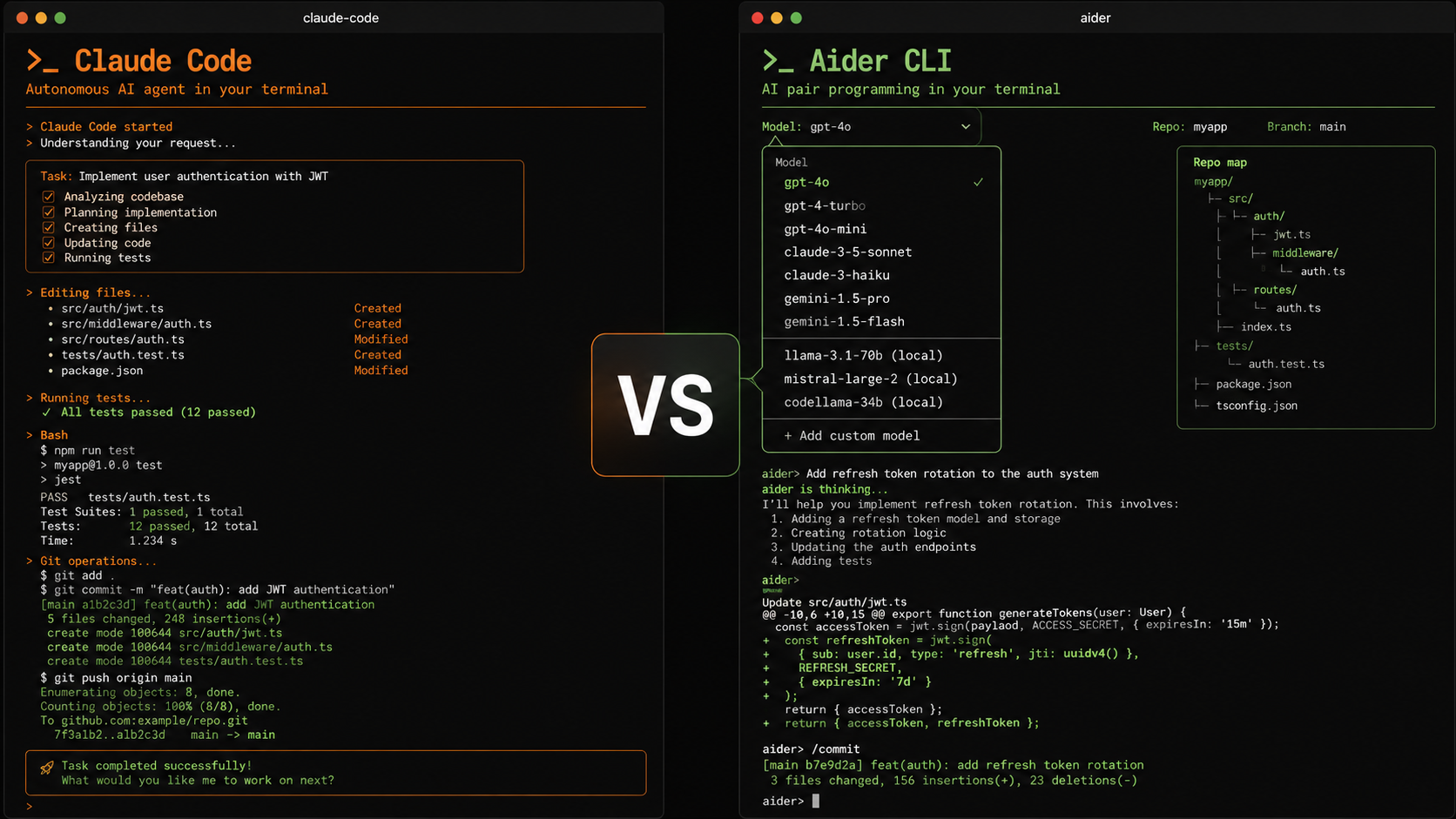
Claude Code vs Aider: CLI Agent Showdown for Terminal Developers (2026)
Last tested: May 2026 · How we test →
Claude Code and Aider are both terminal-first AI coding agents. Both read your codebase, write code across multiple files, and commit to Git. On paper they sound nearly identical. In practice, they represent two very different bets: a polished subscription product versus a free, model-agnostic open-source tool that lets you plug in any LLM you like. This comparison tells you which bet is smarter for your workflow.
The Verdict Up Front
Choose Claude Code if you want the best out-of-the-box agentic experience, don't want to manage API keys and model configs, and are willing to pay $20/month for a polished, reliable CLI agent.
Choose Aider if you want full model freedom, pay only for what you use with zero markup, prefer open-source transparency, or need to run AI coding assistance on local models for privacy.
At-a-Glance Scorecard
| Criterion | Claude Code | Aider | Winner |
|---|---|---|---|
| Agentic autonomy | ★★★★★ | ★★★★☆ | Claude Code |
| Model flexibility | ✗ Anthropic only | ★★★★★ (100+ models) | Aider |
| Pricing / true cost | $20/month flat | Free tool, BYOK | Aider |
| Setup & onboarding | ★★★★☆ | ★★★☆☆ | Claude Code |
| Git integration | ★★★★☆ | ★★★★★ | Aider |
| Large codebase context | ★★★★★ (1M tokens) | ★★★★☆ (repo map) | Claude Code |
| Local / private models | ✗ Not supported | ★★★★★ (Ollama, LM Studio) | Aider |
| UX & polish | ★★★★☆ | ★★★☆☆ | Claude Code |
| Community & update pace | ★★★★☆ | ★★★★★ | Aider |
| Enterprise readiness | ★★★☆☆ | ★★☆☆☆ | Claude Code |
Scored using our 8-criterion testing methodology.
Pricing: The Biggest Difference
| Claude Code | Aider | |
|---|---|---|
| Tool cost | $20/month (Pro) · $100–200/month (Max) | Free (MIT licence) |
| Model cost | Included in subscription | You pay API provider directly |
| Markup on tokens | None (subscription model) | None (direct API billing) |
| Local models | Not supported | Free via Ollama |
| Best-value scenario | Heavy agentic users who'd exceed $20 in raw API costs | Light-to-moderate users, or anyone running local models |
Aider is free as a tool. But "free" means you supply your own API key — for Claude, GPT, Gemini, or whichever model you choose. For heavy users running Claude's API directly, costs can exceed $20/month; for lighter users or those running local models via Ollama, Aider can cost near zero.
The break-even point: if you'd spend less than $20/month on raw Claude API tokens, Aider with Claude's API is cheaper. If you'd spend more, Claude Code's flat subscription is better value.
Head-to-Head: Category by Category
Agentic Autonomy — Claude Code wins
Both tools can tackle multi-file autonomous tasks from the terminal. Claude Code edges ahead on complex, open-ended tasks — particularly those requiring deep reasoning across many files with numerous edge cases. Its SWE-bench Verified score (~80.8%) reflects this, though Aider's score varies significantly depending on which model you pair it with.
Aider's Architect mode (a two-model setup where one model plans and another executes) partially closes this gap, and with the right model pairing it performs excellently on well-scoped tasks.
When it matters: Sprawling refactors, tasks requiring sustained multi-step reasoning with frequent self-correction.
Model Flexibility — Aider wins, decisively
This is Aider's defining advantage. It supports 100+ LLM providers through a unified interface: Anthropic (Claude), OpenAI (GPT-5, o3), Google (Gemini), Mistral, DeepSeek, Groq, and local models via Ollama or LM Studio. You switch models with a flag — --model gpt-4o or --model ollama/qwen2.5-coder — and Aider adapts.
Claude Code is Anthropic-only. There is no model switching, no BYOK, no local model support.
When it matters: Experimenting with new models as they release, cost optimisation by routing tasks to cheaper models, using local models for sensitive codebases.
Git Integration — Aider wins
Aider was built with Git at its core. Every change is auto-committed with a descriptive message, giving you a clean undo trail. It reads your repo's Git history to understand context, respects .gitignore, and handles merge conflicts thoughtfully. You can review, amend, or revert any Aider commit just like a human commit.
Claude Code also uses Git well, but Aider's Git integration is more granular — it's a first-class feature rather than a convenience.
When it matters: Projects where clean commit history matters, teams doing code review on AI-generated changes.
Large Codebase Context — Claude Code wins
Claude Code's 1M token context window lets it ingest large portions of a codebase in a single pass and maintain that awareness across a long agentic session.
Aider takes a different approach: it builds a repo map — a compact, tree-sitter-based summary of your entire codebase's structure — and dynamically loads relevant files into the context window. This is efficient and scales well, but it's a fundamentally different mechanism. On very large codebases with complex cross-cutting concerns, Claude Code's whole-context approach can catch relationships that Aider's repo map misses.
When it matters: Monorepos with 500k+ lines of code, debugging cross-module issues in legacy systems.
Local & Private Models — Aider wins
Claude Code sends your code to Anthropic's servers. Full stop. There is no local model support and no option to opt out of cloud processing.
Aider runs equally well with local models through Ollama or LM Studio. You can run qwen2.5-coder:32b, deepseek-coder, or any other locally hosted model — your code never leaves your machine. For teams with strict data residency requirements or developers working on sensitive proprietary code, this is a decisive advantage.
When it matters: Fintech, healthcare, government, or any team with policies against sending source code to third-party cloud services. For the complete self-hosting setup guide including hardware requirements and performance benchmarks, see Self-Hosted Claude Code Alternatives →.
Setup & Onboarding — Claude Code wins
Claude Code: npm install -g @anthropic-ai/claude-code, authenticate, and you're running. The agent knows what to do from the first prompt.
Aider: pip install aider-chat, set API keys for your chosen provider, understand the repo map concept, learn the /add, /drop, /architect commands, and tune your model configuration. Genuinely not complicated — but there's more to learn before you're productive.
When it matters: Quick evaluations, onboarding non-CLI-native developers, teams that want zero configuration overhead.
UX & Polish — Claude Code wins
Claude Code is a commercial product with a dedicated team focused on the user experience. Error messages are clear, recovery from failed tasks is smooth, and the interaction model is consistent.
Aider is excellent open-source software, but its UX reflects its origins: powerful and configurable, with a steeper learning curve and occasionally rough edges. The tradeoff for that roughness is an update cadence that frequently ships new model support and features faster than any commercial tool.
Community & Update Pace — Aider wins
Aider ships multiple releases per week. New model support lands within days of a model's public release. The GitHub Issues and Discord are actively monitored. With 25,000+ GitHub stars and contributions from hundreds of developers, it moves faster than any single-company product.
Claude Code updates are less frequent but more curated. You get stability and predictability; Aider gives you cutting-edge access.
Real-World Pain Points
Claude Code users say:
- "Rate limits on the $20 plan hit hard during intense sessions"
- "No way to use a different model even when Claude is having a slow day"
- "Wish I could run it on local models for client work with NDAs"
Aider users say:
- "Config overhead is real — took me an afternoon to get the perfect setup"
- "Repo map sometimes misses context that a bigger context window would catch"
- "Quality varies a lot depending on which model I pair it with"
- "No built-in rate limit handling — have to manage that myself per provider"
Decision Tree: Which One Is Right for You?
Choose Claude Code if:
- You want the best polished CLI agent experience without configuration
- You're fine with Anthropic's Claude as your model
- You use it heavily enough that $20/month is worth the flat-rate predictability
- You need consistent, reliable behaviour for critical agentic tasks
Choose Aider if:
- You want to experiment with multiple models or switch based on task type
- Privacy or data residency requirements mean your code can't leave your infrastructure — use Aider with Ollama (full self-hosting guide →)
- You're a light or moderate user where BYOK will cost less than $20/month
- You want open-source transparency and the fastest possible access to new models
- You're already comfortable managing API keys and config
Already decided to switch from Claude Code to Aider? → Step-by-step BYOK migration guide →
Consider alternatives if:
- You want a visual IDE, not just a CLI → see Cursor (Claude Code vs Cursor →)
- You want a free CLI agent without BYOK setup → see Gemini CLI
- You want another open-source CLI option → see OpenCode
- You prefer IDE extensions over terminal tools → see all IDE Extensions →
- You want to compare Copilot as an alternative → see Claude Code vs GitHub Copilot →
- You want all free options compared → see Free Claude Code Alternatives →
- You need a team deployment guide → see Claude Code Alternatives for Teams →
The Bottom Line
Claude Code and Aider are closer competitors than Claude Code and Cursor. Both are terminal-first, both are genuinely agentic, both handle complex multi-file tasks. The real choice is between convenience and model lock-in (Claude Code) versus flexibility and cost control (Aider).
If you want to open your terminal and have something that just works at a high level — Claude Code. If you want to own your stack, choose your model, and pay only for what you use — Aider is one of the most powerful free tools in the CLI Agents category.
Browse the full directory of Claude Code alternatives → across all categories: AI IDEs, CLI Agents, IDE Extensions, and AI App Builders.
FAQ
Is Aider better than Claude Code? For model flexibility, cost control, and local model support — yes. For out-of-the-box polish and the strongest agentic reasoning on complex tasks — Claude Code wins. Neither is universally better.
Can Aider use Claude?
Yes. Aider works with Anthropic's Claude models via API key. Run aider --model claude-sonnet-4-5 and you get Claude's capabilities through Aider's interface — without a Claude Code subscription.
Is Aider really free? The Aider tool itself is free and open-source. You pay only for the API tokens consumed by whichever model you choose. With local models via Ollama, it can cost nothing at all.
Which is better for a team? Claude Code has a more predictable cost structure for teams (Max plan). Aider gives teams model flexibility but requires each developer to manage their own API keys and configuration, which adds overhead. For a full team comparison, see Claude Code Alternatives for Teams →.
Does Aider work offline? Not with cloud models — those require internet. But with local models via Ollama or LM Studio, Aider works fully offline. Claude Code has no offline mode. Full self-hosting setup: Self-Hosted Claude Code Alternatives →.
How do I switch from Claude Code to Aider? See our step-by-step guide: How to Switch from Claude Code to Aider → — covers install, API key setup, CLAUDE.md migration, Architect mode, and local models with Ollama.
See all CLI Agents → or browse the full Claude Code alternatives directory →