
QwenLM
Command-line agentic coding tool optimized for Alibaba's Qwen3-Coder models with free-tier access.
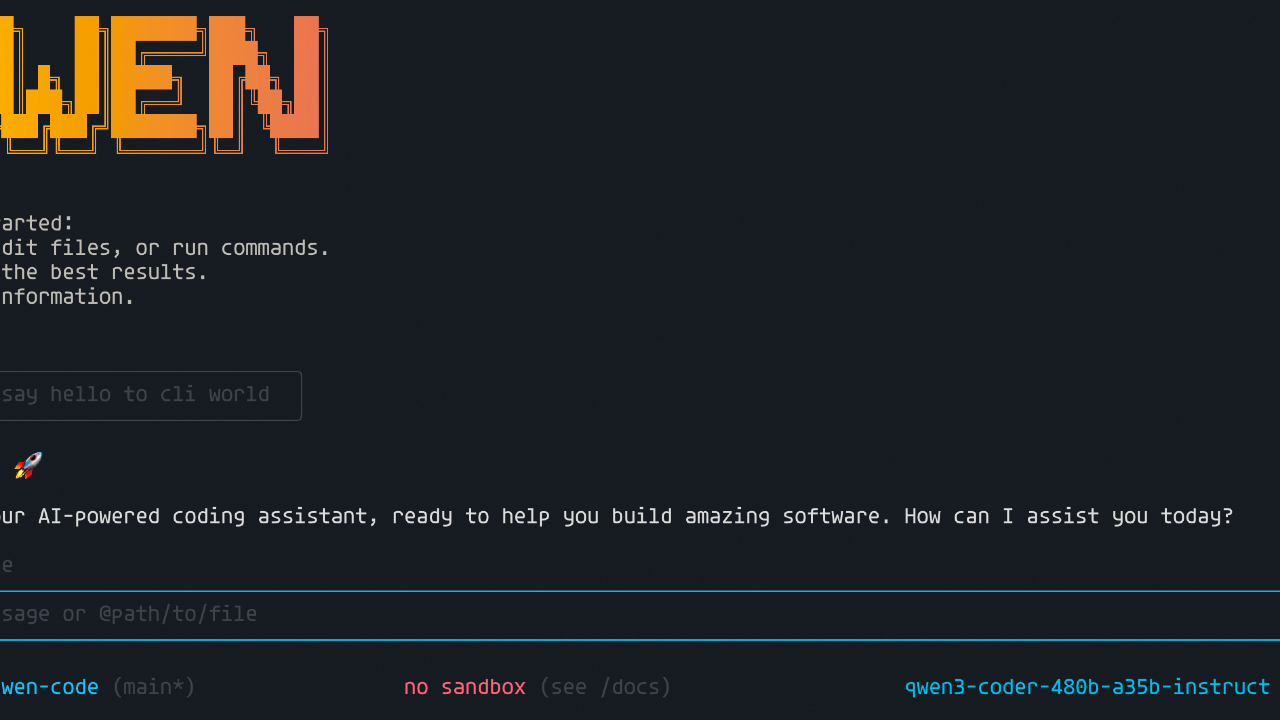
Qwen Code - Claude code alternative
Qwen Code is a terminal-based AI workflow tool adapted from Gemini CLI, specifically optimized for Qwen3-Coder models. It operates as a Read-Eval-Print Loop (REPL) environment where developers interact with AI models through command-line commands. The tool excels at code understanding, workflow automation, and intelligent assistance, featuring an enhanced parser specifically adapted for Qwen-Coder models. Solo developers may prefer it because it offers 2,000 free requests per day with no token limits through Qwen OAuth authentication, eliminating cost concerns for individual users.
Strengths
- Free tier provides 2,000 requests per day with 60 requests per minute rate limit through Qwen OAuth, requiring zero configuration beyond browser authentication.
- Supports querying and editing large codebases beyond traditional context window limits through specialized parser adaptations.
- Powered by Qwen3-Coder-480B-A35B, a Mixture-of-Experts model with 480 billion total parameters and 35 billion active parameters that achieves state-of-the-art results on agentic coding benchmarks.
- Native support for 256K token context length, extendable to 1 million tokens using YaRN extrapolation methods for repository-scale understanding.
- Includes vision model auto-switching that detects images in input and automatically switches to vision-capable models for multimodal analysis.
- Multiple free API provider options including OpenRouter (1,000 free calls/day internationally) and ModelScope (2,000 free calls/day in mainland China).
Weaknesses
- Token usage may be higher than expected because the tool issues multiple API calls per cycle, similar to Claude Code's behavior.
- Free Qwen OAuth tier may experience model fallback to maintain service quality during high-demand periods.
- Requires Node.js version 20 or higher, limiting compatibility with older development environments.
- Terminal-only interface requires comfort with command-line workflows, lacking GUI alternatives.
- Forked from Gemini CLI, meaning core architecture decisions inherit upstream design constraints.
Best for
Developers who work primarily in terminal environments and want free access to powerful agentic coding capabilities without usage limits. Ideal for open-source contributors, students, and solo developers optimizing for cost while requiring repository-scale code understanding.
Pricing plans
- Qwen OAuth (Free) — $0/month — 2,000 requests/day, 60 requests/minute, no token counting, automatic credential refresh
- OpenRouter Free Tier — $0/month — Up to 1,000 free API calls/day (international users)
- ModelScope Free Tier — $0/month — 2,000 free API calls/day (mainland China users)
- Alibaba Cloud ModelStudio (Pay-as-you-go) — Variable pricing — qwen3-coder-plus uses tiered billing based on input tokens per request; qwen3-coder-flash offers lower-cost alternative with context cache support at 20% pricing for implicit cache hits and 10% for explicit cache hits
- OpenRouter Paid — $0.22/million input tokens, $0.95/million output tokens for Qwen3-Coder-480B-A35B (pricing varies by context length above 128K tokens)
Tech details
- Type: Command-line agentic coding tool
- IDEs: Terminal-based REPL interface; supports IDE integration through documented extensions
- Key features: Code understanding & editing, workflow automation (pull requests, rebases), enhanced parser for Qwen-Coder, vision model auto-switching, configurable session token limits (/compress, /clear, /stats commands), git automation, file operations
- Privacy / hosting: Client-side CLI application communicates with local server component; API calls route through chosen provider (Qwen OAuth, Alibaba Cloud, OpenRouter, or ModelScope); no self-hosted option required
- Models / context window: Qwen3-Coder-480B-A35B-Instruct (480B parameters, 35B active, 256K native context, 1M with YaRN), Qwen3-Coder-30B-A3B-Instruct (30.5B parameters, 3.3B active); trained on 7.5 trillion tokens with 70% code ratio
When to choose this over Claude code
- You need genuinely free access with 2,000 daily requests and no token counting requirements, eliminating cost concerns for solo developers.
- You work with extremely large codebases requiring 256K native context or up to 1 million tokens with extrapolation.
- You prioritize open-source models with state-of-the-art agentic coding performance comparable to proprietary alternatives on benchmarks like SWE-Bench.
When Claude code may be a better fit
- You prefer integrated IDE experiences over terminal-based workflows and want seamless editor integration.
- You require established enterprise support contracts and guaranteed uptime SLAs not available with free-tier services.
- You need consistent model performance without potential fallback behavior during high-demand periods.
Conclusion
Qwen Code serves as a compelling Claude code alternative for developers comfortable with command-line workflows who value cost-free access to cutting-edge agentic coding capabilities. Its generous free tier (2,000 requests/day) combined with Qwen3-Coder's strong performance on coding benchmarks makes it particularly attractive for solo developers, students, and open-source contributors. The tool's specialized parser adaptations for Qwen models and support for massive context windows (up to 1M tokens) enable sophisticated repository-scale analysis. However, users should be aware of higher token consumption per cycle and potential model fallback on free tiers.
Sources
- Official site: https://qwenlm.github.io/blog/qwen3-coder/
- GitHub: https://github.com/QwenLM/qwen-code
- Documentation: https://qwenlm.github.io/qwen-code-docs/en/
- Pricing (Alibaba Cloud): https://www.alibabacloud.com/help/en/model-studio/models
- OpenRouter pricing: https://openrouter.ai/qwen/qwen3-coder
FAQ
What makes Qwen Code different from Claude Code?
Qwen Code offers 2,000 completely free requests per day with no token counting through Qwen OAuth authentication, while Claude Code operates on a paid subscription model. Additionally, Qwen Code is optimized for Alibaba's open-source Qwen3-Coder models rather than proprietary Claude models, and it was adapted from Gemini CLI with parser-level modifications.
How much does Qwen Code actually cost to use?
The Qwen OAuth option is completely free with 2,000 requests per day and 60 requests per minute. OpenRouter provides up to 1,000 free API calls per day internationally, and ModelScope offers 2,000 free calls per day for users in mainland China. Paid options through Alibaba Cloud use tiered billing, while OpenRouter charges $0.22 per million input tokens and $0.95 per million output tokens for the 480B model.
What context window size does Qwen Code support?
Qwen3-Coder supports 256K tokens natively and can be extended up to 1 million tokens using YaRN extrapolation methods. The tool includes configurable session token limits that you can adjust through the .qwen/settings.json file to optimize costs and performance.
Do I need to install anything besides Node.js?
Yes, you need Node.js version 20 or higher installed. Then you can install Qwen Code globally via npm (npm install -g @qwen-code/qwen-code@latest), clone from GitHub, or use Homebrew (brew install qwen-code). After installation, simply run 'qwen' to start, and the CLI will handle authentication through your browser automatically.
Can Qwen Code work with images or just code?
Yes, Qwen Code includes intelligent vision model auto-switching that automatically detects images in your input and seamlessly switches to vision-capable models for multimodal analysis. This feature is enabled by default with configurable behavior through command-line flags (--vlm-switch-mode) or settings.json configuration.
How does token usage compare to Claude Code?
Qwen Code may issue multiple API calls per cycle, resulting in higher token usage similar to Claude Code, and the team is actively optimizing API efficiency. You can monitor usage with the /stats command and compress conversation history using /compress to continue within token limits. The configurable sessionTokenLimit setting helps control costs by limiting tokens per conversation.