
OpenCode
Open-source terminal-based AI coding agent supporting 75+ LLM providers with local-first architecture.
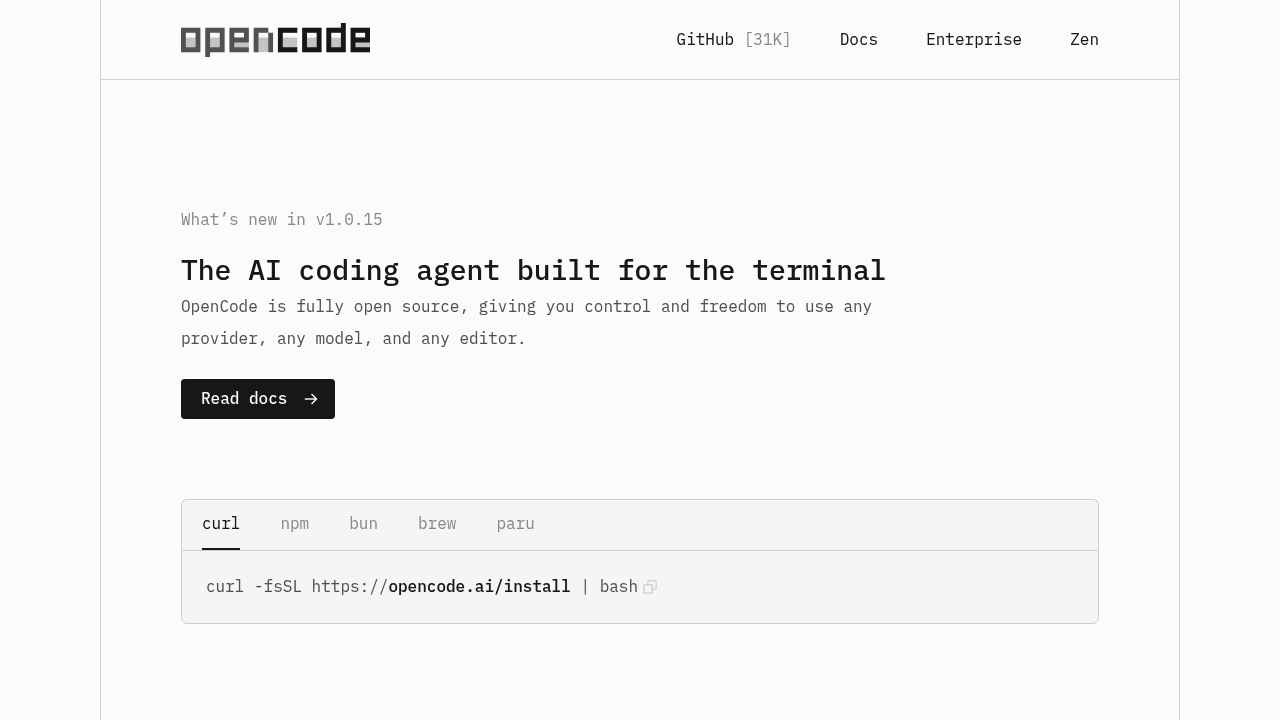
OpenCode - Claude code alternative
OpenCode is an open-source AI coding agent that operates directly in the terminal. It works with any provider including OpenAI, Google, or local models, unlike Claude Code which is coupled to Anthropic. The tool automatically loads Language Server Protocol (LSP) servers to help AI make fewer mistakes when writing code. Solo developers who prefer command-line workflows gain full control over their AI provider and data privacy.
Strengths
- Provider-agnostic design supports OpenAI, Anthropic, Google, AWS Bedrock, Groq, Azure OpenAI, OpenRouter, and local models. Switch between 75+ models without vendor lock-in.
- LSP integration automatically provides code intelligence features including diagnostics, error checking, and linting across multiple programming languages.
- Session management saves and manages multiple conversation sessions with persistent storage using SQLite database.
- Model Context Protocol (MCP) support allows adding external tools through local or remote MCP servers.
- Client/server architecture enables running OpenCode on your computer while driving it remotely from a mobile app.
- VS Code extension integrates with keyboard shortcuts for quick launch and context-aware file sharing.
Weaknesses
- Early development stage with features that may change, break, or remain incomplete. Not production-ready.
- Token consumption can balloon to 150k+ tokens quickly in agentic mode, increasing costs unexpectedly.
- Fetched documentation can exceed context limits. Manual session editing sometimes required.
- VS Code integration lacks some features compared to Claude Code extension, such as seamless highlighted code addition.
Best for
Developers who prefer terminal workflows and want provider flexibility with local-first data control. Teams requiring self-hosted solutions or strict data compliance.
Pricing plans
- Free — $0 — Open-source tool with no subscription fees. Users pay only for API usage from their chosen LLM provider.
- OpenCode Zen (Beta) — Pay-as-you-go — Curated models with pricing per 1M tokens (e.g., Claude Haiku 3.5, Grok Code Fast 1 currently free). Credit card fees passed at cost.
- Third-party integrations — GLM Coding Plan starts at $3/month through Z.AI for use with OpenCode. Includes higher usage quotas.
Tech details
- Type: Terminal-based AI coding agent with TUI (Terminal User Interface)
- IDEs: VS Code, Cursor, Windsurf, VSCodium, or any IDE supporting integrated terminal. Extension available for keyboard shortcuts.
- Key features: Multi-agent support (Build/Plan primary agents, specialized subagents), custom commands, file change tracking, Vim-like editor, Git integration, session sharing via links.
- Privacy / hosting: Local-first architecture does not store code or context data. Runs on user's machine. Users control which data gets shared with AI providers.
- Models / context window: Supports multiple model families including GPT-4.1, Claude, Gemini, AWS Bedrock models. Context windows vary by model (typically 200K-1M tokens for modern models). Claude Sonnet 4 uses 200K token context window.
When to choose this over Claude code
- You want provider flexibility to use OpenAI, Google, or local models instead of being locked to Anthropic.
- You prefer terminal user interface (TUI) workflows and are a Neovim user or terminal power user.
- You need full data privacy with local-first architecture where code never leaves your machine unless explicitly shared with chosen API.
When Claude code may be a better fit
- You prefer a polished, production-ready tool without early-stage instability risks.
- You want integrated Claude Pro/Max subscription usage without managing multiple API keys.
- You need predictable context management without manual token monitoring to avoid unexpected cost spikes.
Conclusion
OpenCode delivers a Claude code alternative for terminal-focused developers who value provider flexibility and data control. With over 29,000 GitHub stars and 250,000 monthly users, the community actively maintains this open-source project. The LSP integration and MCP support provide extensibility. Token management requires attention due to rapid context growth in agentic workflows.
Sources
- Official site: https://opencode.ai/
- Docs: https://opencode.ai/docs/
- Pricing: https://opencode.ai/docs/zen/
FAQ
What makes OpenCode different from Claude Code?
OpenCode is not coupled to any provider, supporting OpenAI, Google, and local models alongside Anthropic. It features a terminal-focused TUI design and client/server architecture for remote operation.
Can I use my Claude Pro subscription with OpenCode?
OpenCode integrates with Anthropic, allowing use of Claude Pro or Max subscriptions through OAuth authentication. Configure your credentials through the authentication flow.
Does OpenCode work with VS Code?
Yes, OpenCode integrates with VS Code, Cursor, and similar IDEs through an extension providing keyboard shortcuts. Use Cmd+Esc (Mac) or Ctrl+Esc (Windows/Linux) for quick launch.
How much does OpenCode cost?
OpenCode is free and open-source. Users pay only for LLM API usage from their chosen provider. Optional OpenCode Zen offers pay-as-you-go pricing for curated models.
Can I use local AI models with OpenCode?
Yes, OpenCode supports local models alongside cloud providers. Configure self-hosted models through the LOCAL_ENDPOINT environment variable.
What is MCP support in OpenCode?
Model Context Protocol (MCP) allows adding external tools to OpenCode through local or remote servers. MCP tools become available alongside built-in tools with the same permission model.