Morph: A Claude Code Alternative for Ultra-Fast AI Code Editing Infrastructure
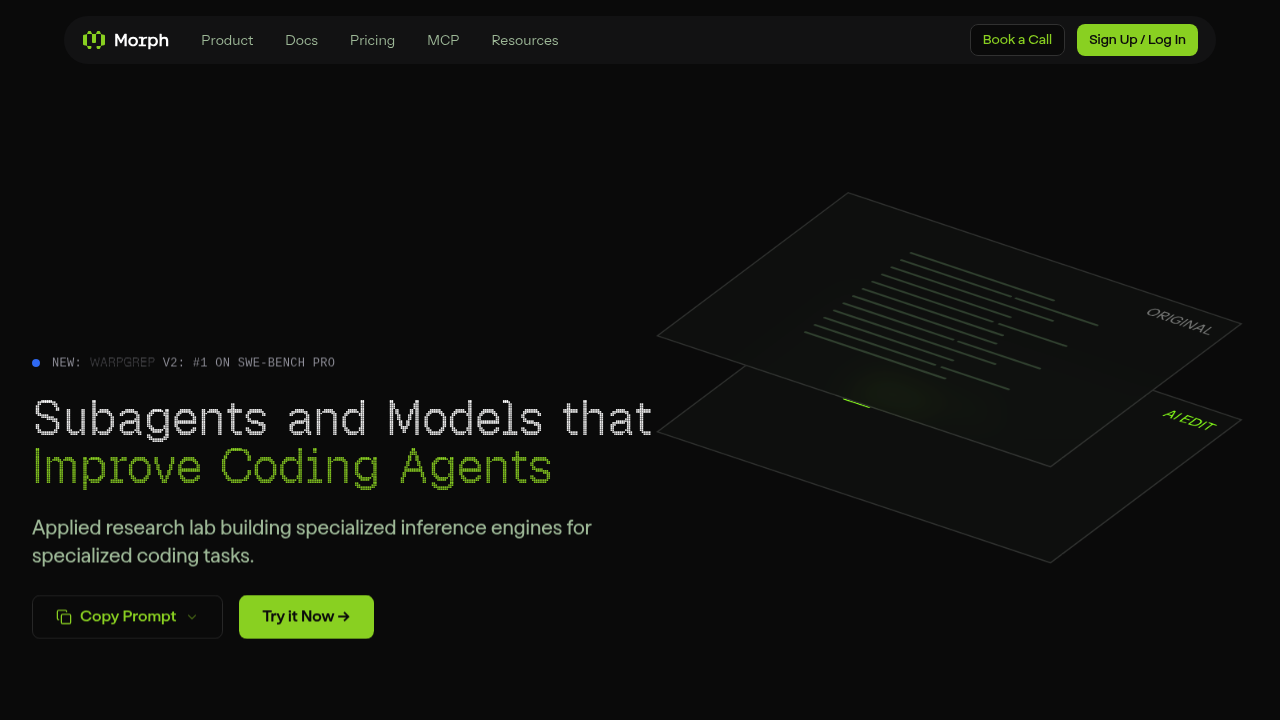
Morph is an AI coding infrastructure platform ranked #1 on SWE-Bench Pro, delivering purpose-built code editing and search capabilities at speeds that leave conventional approaches far behind. Rather than competing as an end-user coding assistant, Morph operates as an infrastructure layer — an AI API and MCP-accessible toolkit that accelerates the underlying capabilities of existing coding agents including Claude Code, Cursor, and VS Code. Morph is the engine behind the edit; it doesn't replace Claude Code so much as make any agent that uses it dramatically faster and more accurate.
Morph's flagship capability is its code editing engine, morph-v2, which applies AI-generated edits at over 10,500 tokens per second — roughly 10x faster than alternatives. This speed isn't just a benchmark: it translates to near-instant code updates in agentic workflows, eliminating the re-read cycles and edit failures that slow down other approaches. Complementing this is Morph's parallel agentic code search (WarpGrep), near-lossless context compaction at 33,000 tokens/sec, and a unique AI-driven PR testing feature that embeds a video of an AI agent testing changes directly in GitHub pull requests.
For developers and teams looking at Morph as a Claude Code alternative, the framing is more nuanced than a direct replacement. Morph is the infrastructure that makes Claude Code-style agents work better — faster edits, better search, and reduced context loss. It can be accessed via an OpenAI-compatible API, MCP server, or through integrations with AI SDK and OpenRouter. SOC2 certification and self-hosted deployment options make it suitable for enterprise environments.
Morph vs Claude Code: Feature Comparison
| Feature |
Morph |
Claude Code |
| Primary role |
AI coding infrastructure / fast edit API |
End-user agentic coding assistant |
| Code editing speed |
10,500+ tokens/sec (10x faster than alternatives) |
Standard LLM generation speed |
| SWE-Bench Pro ranking |
#1 |
Not independently ranked at this level |
| Agentic code search |
Yes (WarpGrep, parallel tool calling harness) |
Basic file/code search |
| Context compaction |
Near-lossless, 50–70% at 33K tok/sec |
No built-in compaction |
| AI PR testing with video |
Yes (embedded in GitHub PR) |
No |
| OpenAI-compatible API |
Yes |
No |
| MCP integration |
Yes |
Yes |
| Self-hosted / enterprise |
Yes (SOC2, on-prem, SSO) |
No |
| Standalone IDE/CLI |
No (API/infrastructure layer) |
Yes (CLI) |
Key Strengths of Morph
- #1 SWE-Bench Pro performance with 10x edit speed: Morph's morph-v2 model applies code edits at over 10,500 tokens per second — an order of magnitude faster than competing approaches. On SWE-Bench Pro, Morph ranked first, demonstrating that its code editing accuracy surpasses other methods at production-grade complexity. For agentic workflows where the bottleneck is edit latency, Morph's speed translates directly to developer productivity.
- Near-lossless context compaction: Morph compacts context windows by 50–70% at 33,000 tokens/sec while achieving only a +0.6% loss on SWE-Bench Pro tasks. For long coding sessions where context windows fill up and agent performance degrades, Morph's compaction keeps agent quality high without the reset cost of starting fresh. This is one of the most practically impactful capabilities for long-running agentic workflows.
- AI agent PR testing with embedded video: Morph's PR testing feature generates a video of an AI agent testing code changes and embeds it directly in GitHub pull requests. Reviewers can see exactly what the AI tested, what it found, and how the feature behaves — without setting up a separate test environment or reading through test logs. This brings a new level of transparency to AI-assisted development.
- Works alongside any agent via OpenAI-compatible API and MCP: Morph integrates with Claude Code, Cursor, VS Code, and other agents through an OpenAI-compatible API and MCP server. Rather than replacing your existing stack, Morph amplifies it — providing faster edits and better search to whatever agent is driving the workflow. The 8-line integration promise makes adoption low-friction.
- Enterprise-grade security and deployment: Morph is SOC2 certified and offers self-hosted deployment on-premises or in your own cloud environment. For organizations with compliance requirements, Morph provides the security posture that many AI coding tools lack. High rate limits and 99.9% uptime SLA support production-grade usage.
Known Limitations
- Infrastructure layer, not a standalone developer tool: Morph is not a tool developers use directly in the way they use Claude Code or Kiro. It's an API and MCP server that other agents call. Solo developers looking for a simple AI coding assistant won't find Morph useful without an existing agent setup. It requires technical integration and is most valuable to teams building or operating sophisticated AI coding pipelines.
- Credit/token-based pricing can scale quickly: At the Scale tier ($400/mo for 80M credits), Morph pricing grows with usage intensity. Teams running high-volume agentic workflows will need to plan for significant costs. The credit-based model provides flexibility but requires careful monitoring for cost predictability.
- No user interface of its own: Morph has no standalone IDE, CLI, or chat interface for developers. All interaction is via API calls from another tool or agent. This means Morph adoption always requires pairing it with a primary coding environment or agentic tool.
- Newer product with evolving ecosystem: While the technical benchmarks are impressive, Morph's community, third-party integrations, and tutorial ecosystem are still maturing. Teams adopting Morph early may encounter less documentation and community support than with more established tools.
Best For
Morph is best for engineering teams and AI developers who are building or operating agentic coding pipelines and want to maximize the speed, accuracy, and context longevity of those pipelines. Platform teams at startups or enterprises who have adopted Claude Code, Cursor, or custom LLM-based coding agents will find Morph's capabilities directly translate to faster feature delivery and higher-quality code changes.
Organizations with compliance requirements who need self-hosted AI infrastructure, SOC2 certification, and high rate limits for production-grade agentic workflows are a natural fit. AI SDK developers building custom coding assistants will also benefit from Morph's OpenAI-compatible API as a speed-optimized backend for edit operations.
Pricing
Morph's pricing is credit-based and scales from individual exploration to enterprise deployment:
- Free: $0/month — 200 requests/month, 250K credits
- Starter: $20/month — 3M credits
- Pro: $60/month (currently $20/month for first month) — 10M credits
- Scale: $400/month — 80M credits, near-unlimited rate limits
- Enterprise: Custom pricing — self-hosted, SSO, dedicated infrastructure, ready-to-sign agreements
Tech Details
- Core Models: morph-v2 (purpose-built code editing), morph-router (difficulty-based routing)
- Edit Speed: 10,500+ tokens/second
- Code Search: WarpGrep (parallel tool calling harness, 15.8% cheaper and 22% faster than alternatives)
- Context Compaction: 50–70% reduction at 33,000 tok/sec, near-lossless (+0.6% on SWE-Bench Pro)
- Access Methods: OpenAI-compatible API, MCP server, AI SDK, OpenRouter
- Integrations: Claude Code, Cursor, VS Code, GitHub (PR testing)
- Security: SOC2 certified, enterprise ready-to-sign agreements
- Deployment: Cloud (Morph cloud) or self-hosted (Enterprise)
- SLA: 99.9% uptime
- Open Source: No
When to Choose Morph Over Claude Code
Choose Morph when you're running agentic coding pipelines and the bottleneck is edit speed, context quality, or search accuracy — not the high-level decision making. If your Claude Code or Cursor agents are slow because LLM edit application is sluggish, context windows are overflowing mid-task, or code search is returning noisy results, Morph directly addresses each of those constraints. It's the right choice when you want to amplify an existing agentic workflow rather than replace it.
Morph is also the clear choice for organizations that need SOC2-certified AI infrastructure for compliance reasons, or that want to self-host AI coding capabilities on their own infrastructure for data sovereignty.
When Claude Code May Be a Better Fit
Claude Code is the better fit for individual developers who want a ready-to-use agentic coding assistant without API integration work. Claude Code works out-of-the-box as a terminal tool — no infrastructure setup required. For teams that don't have the engineering capacity to integrate an API-based infrastructure layer, or whose workflows don't involve complex multi-agent pipelines, Claude Code's simpler deployment model is more accessible and immediately productive.
Conclusion
Morph occupies a unique position in the Claude Code alternatives landscape: it's not trying to be Claude Code, it's trying to make Claude Code (and every other coding agent) better. With the #1 SWE-Bench Pro ranking, 10x faster code edits, near-lossless context compaction, and AI-driven PR testing, Morph addresses the fundamental infrastructure bottlenecks that limit agentic coding at scale. For organizations serious about AI-assisted development at production quality, Morph is the infrastructure layer that turns good agents into great ones.
Sources
Frequently Asked Questions
Can Morph work alongside Claude Code?
Yes. Morph is designed to work alongside Claude Code, Cursor, VS Code, and other agents. It integrates via MCP server and OpenAI-compatible API, acting as the fast code editing and search backend for whatever agent is running the workflow. Morph amplifies existing agents rather than replacing them.
What is WarpGrep?
WarpGrep is Morph's agentic code search tool built on a parallel tool calling harness. It delivers code search results 15.8% more cheaply and 22% faster than alternatives, making it significantly more efficient for agents that need to navigate and understand large codebases in the course of autonomous coding tasks.
Is Morph available for individual developers or only enterprises?
Morph is available to individual developers through its Free (200 requests/month) and Starter ($20/month) tiers. These tiers provide API access to morph-v2 and WarpGrep for developers building or experimenting with agentic coding workflows. Enterprise features like self-hosted deployment and SSO are reserved for the Enterprise tier.
What does "near-lossless context compaction" mean in practice?
Context compaction reduces the size of the context window by 50–70% while retaining the information needed for accurate code editing. Morph's compaction adds only +0.6% error rate (on SWE-Bench Pro) compared to using the full context. In practice, this means agents can work longer on complex tasks without hitting context limits or experiencing quality degradation — a significant advantage for large-scale refactoring or multi-file feature development.