
Devin
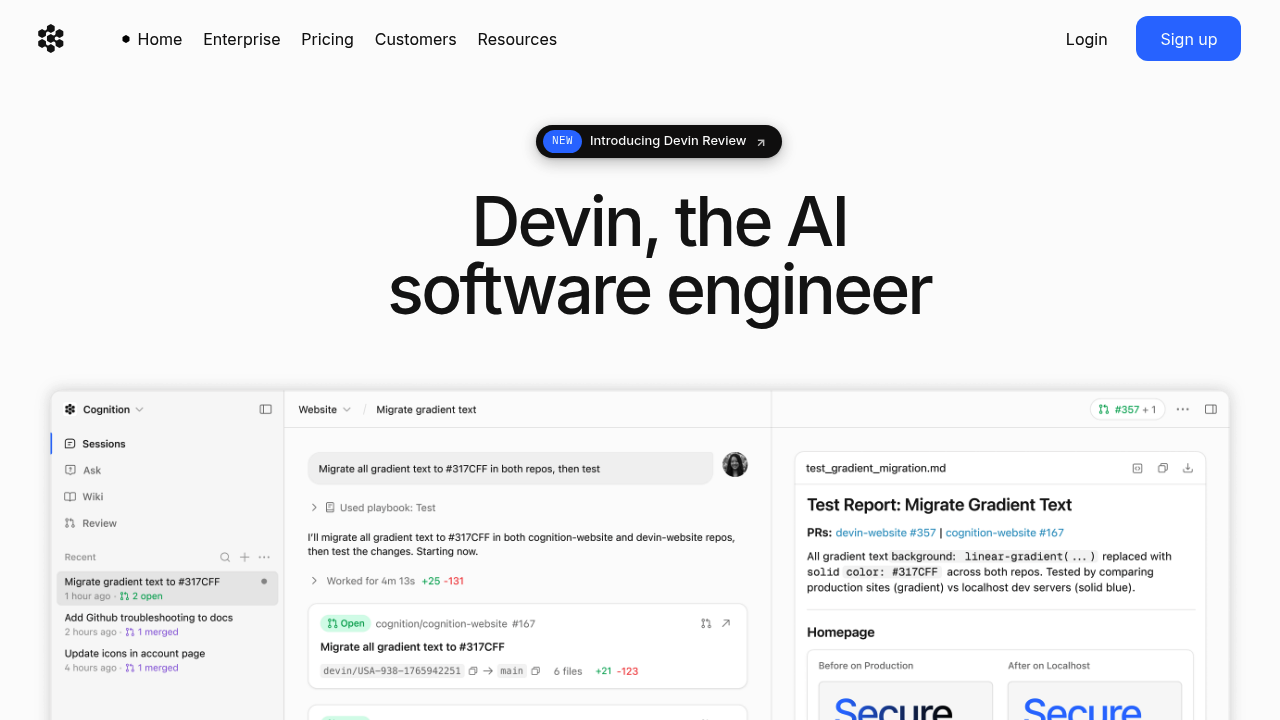
Devin is a cloud-based autonomous AI software engineer by Cognition AI that handles complete coding tasks end-to-end — from reading issues and writing code to running tests and opening pull requests — without continuous human guidance.
Devin: A Claude Code Alternative for Fully Autonomous Software Engineering
Devin is a cloud-based autonomous AI software engineer developed by Cognition AI. Unlike typical code assistants that suggest snippets or complete lines, Devin is designed to handle complete engineering tasks end-to-end — from reading a GitHub issue to writing code, running tests, debugging failures, and opening a pull request — all without continuous human guidance. As a Claude Code alternative, it is best suited for engineering teams that want to delegate entire tasks rather than individual coding steps, particularly for repetitive migrations, bug fixes, and feature implementation at scale.
Devin vs. Claude Code: Quick Comparison
| Devin | Claude Code | |
|---|---|---|
| Type | Cloud-based autonomous AI software engineer | CLI Agent |
| IDEs | No local IDE required; browser-based dashboard + Slack integration | Any editor via CLI / terminal |
| Pricing | Core: $20/month minimum ($2.25/ACU); Teams: $500/month (250 ACUs at $2.00/ACU) | Usage-based via Anthropic API; ~$3–15/MTok |
| Models | Proprietary Cognition models (not publicly documented) | Claude 3.5 / Claude 3 Opus |
| Privacy / hosting | Cloud (Cognition AI managed) | Cloud (Anthropic API) |
| Open source | No | No |
| Offline / local models | No | No |
Key Strengths
- True end-to-end autonomy: Devin can accept a task in natural language, explore a codebase, set up environments, write and test code, and open a pull request — all without step-by-step human prompting. This makes it distinctly different from interactive AI code assistants that require the human to stay in the loop at every stage.
- Parallel task execution: Devin supports running multiple instances simultaneously, allowing engineering teams to parallelize workloads across dozens or hundreds of sub-tasks. Cognition's case study with Nubank demonstrated a 8–12x efficiency gain and over 20x cost savings on a large-scale ETL migration by running parallel Devin instances.
- Fine-tuning and task specialization: Devin can be fine-tuned on specific codebase patterns and migration examples. After exposure to examples of how engineers have handled similar tasks, Devin improves its accuracy and speed on the same class of problem. Cognition documented a 2x improvement in task completion scores and a 4x improvement in task speed after fine-tuning for Nubank's migration.
- Integrations with developer tools: Devin integrates with GitHub, GitLab, Slack, and Jira, enabling task delegation directly from existing workflows. Engineers can assign Devin tasks through Slack messages or by linking GitHub issues, and Devin will report back with progress updates and PR links.
- Persistent knowledge and learning: Over time, Devin accumulates familiarity with a codebase's patterns and common pitfalls, becoming faster and more reliable with repeated exposure. This compounding improvement was noted in real-world deployments at enterprise scale.
Known Limitations
- Cost at scale: While the Core plan starts at just $20/month, each ACU (Agent Compute Unit) represents approximately 15 minutes of Devin's active work. For complex tasks requiring hours of processing, costs can accumulate quickly. Teams should carefully estimate task volume before committing to a plan.
- Closed, proprietary system: Devin is entirely cloud-based and closed source. Teams with strict data sovereignty requirements, on-premises mandates, or needs for custom model integrations cannot self-host or audit Devin's internals. There is no support for local models or offline operation.
- Not suited for interactive pair programming: Devin is designed for autonomous task delegation, not for real-time collaborative coding sessions. Developers who prefer interactive, step-by-step AI assistance within their own editor will find Claude Code or other IDE-focused tools a better fit.
- Task complexity limits: While Devin handles well-defined tasks with clear scope very effectively, highly ambiguous or open-ended architectural decisions may require more human guidance and iteration.
Best For
Devin is best suited for engineering teams dealing with high-volume, repetitive coding work: large-scale migrations, dependency upgrades, test generation, bug triage and fixes, and boilerplate feature implementation. It excels in organizations with codebases large enough that paying for human engineering time on mechanical tasks is expensive. Teams at mid-to-large companies looking to free senior engineers from grunt work will see the clearest ROI. Companies already using GitHub, Slack, and Jira will benefit from its native integrations without significant workflow changes.
Pricing
- Core Plan: $20/month minimum; ACUs billed at $2.25 each; pay-as-you-go with auto-recharge settings
- Teams Plan: $500/month; includes 250 ACUs at $2.00/ACU; designed for team-level usage
- Enterprise: Custom pricing; contact Cognition AI for volume, SLA, and advanced features
Prices are subject to change. Check the official pricing page for current details.
Tech Details
- Type: Cloud-based autonomous AI software engineer
- IDEs: Browser dashboard, Slack integration, GitHub/GitLab integration; no local IDE plugin required
- Key features: End-to-end task execution, parallel agent instances, fine-tuning on codebases, PR creation, test running, environment setup, Slack/GitHub/GitLab/Jira integrations
- Privacy / hosting: Cloud (Cognition AI managed infrastructure)
- Models / context window: Proprietary Cognition models — not publicly documented
When to Choose This Over Claude Code
- When you want to delegate entire tasks (not just code suggestions) and have Devin work autonomously for hours without interruption
- When your team has large volumes of repetitive coding work (migrations, upgrades, test generation) that would otherwise require significant engineering hours
- When you're already using GitHub, Slack, or Jira and want task delegation to feel native to your existing workflow
- When you want to run multiple parallel coding workloads simultaneously to compress timelines
When Claude Code May Be a Better Fit
- When you prefer interactive, step-by-step AI assistance directly in your terminal or preferred editor rather than delegating tasks to a cloud agent
- When your codebase or data has strict on-premises or data sovereignty requirements that prevent use of external cloud services
- When you want full control over the AI model being used, including the ability to swap in different Claude versions or configure context precisely
- When cost predictability is critical and usage-based per-ACU billing is harder to forecast than per-token API pricing
Conclusion
Devin is a compelling Claude Code alternative for teams that want to move beyond interactive AI assistance toward true task delegation. Its ability to handle end-to-end software engineering tasks autonomously — including environment setup, coding, testing, and PR creation — makes it uniquely suited for high-volume, repetitive engineering work at scale. Teams willing to embrace a cloud-first, autonomous workflow and invest in fine-tuning Devin on their codebase will see significant productivity gains over traditional AI coding assistants.
Sources
FAQ
Is Devin free?
Devin is not free, but it offers a Core plan with a $20/month minimum, where you pay $2.25 per ACU (Agent Compute Unit). There is no permanently free tier, though pricing is significantly more accessible than the original $500/month launch price.
Does Devin work with VS Code?
Devin does not have a VS Code extension. It operates as a cloud agent accessed via a browser dashboard and integrates with Slack, GitHub, and GitLab. Developers interact with Devin through these platforms rather than within their local IDE.
How does Devin compare to Claude Code?
Claude Code is an interactive CLI agent that works alongside a developer in real-time within their terminal, requiring ongoing guidance. Devin is designed to work autonomously on complete tasks without continuous human input, making it better for task delegation while Claude Code is better for interactive coding sessions.
What is an ACU (Agent Compute Unit) in Devin?
An ACU represents approximately 15 minutes of Devin actively working on a task. On the Core plan, each ACU costs $2.25, meaning one hour of Devin's time costs approximately $9. The Teams plan offers a slightly lower rate of $2.00/ACU with 250 ACUs included in the $500/month subscription.
Can Devin be self-hosted or used with custom models?
No. Devin is a fully cloud-based, closed-source product managed by Cognition AI. It cannot be self-hosted, and its underlying model is proprietary. Organizations with strict data sovereignty requirements should evaluate this before adopting Devin.