Claw Code Agent: A Claude Code Alternative for Local Python-First Coding Agents
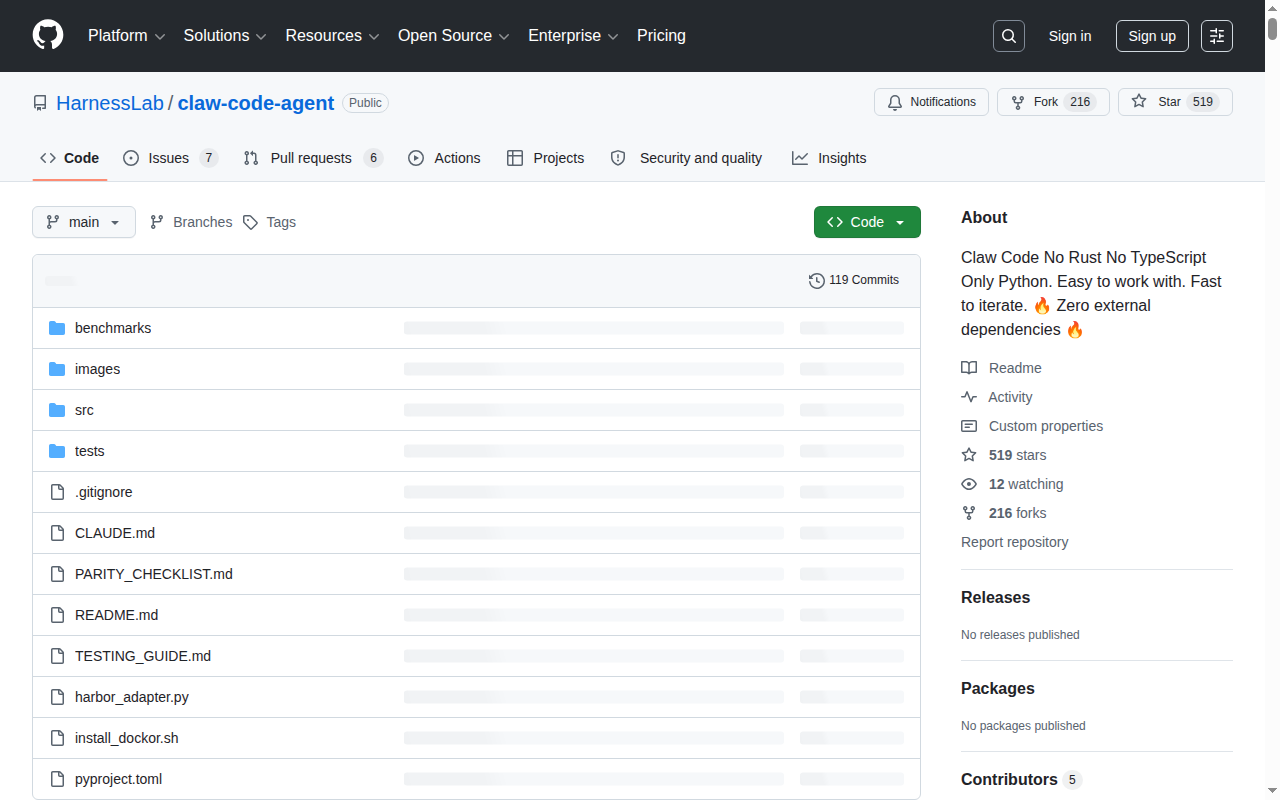
Claw Code Agent is a Python reimplementation of the Claude Code agent architecture published by HarnessLab. It is built for developers who want local control, OpenAI-compatible backends, and a hackable agent runtime without Rust or TypeScript dependencies. As a Claude Code alternative, it is best suited for power users who want to run coding agents with local or self-chosen models and tune the runtime in detail.
Claw Code Agent vs. Claude Code: Quick Comparison
| Claw Code Agent | Claude Code |
|---|
| Type | CLI Agent | CLI Agent |
| IDEs | CLI first; optional local web GUI | Any editor via CLI / terminal |
| Pricing | Free and open source | Usage-based via Anthropic API; ~$3–15/MTok |
| Models | OpenAI-compatible backends, vLLM, Ollama, LiteLLM Proxy, OpenRouter; Qwen3-Coder highlighted | Claude 3.5 / Claude 3 Opus |
| Privacy / hosting | Local / self-hosted by default | Cloud (Anthropic API) |
| Open source | Yes | No |
| Offline / local models | Yes | No |
Key Strengths
- Python-first implementation: The project is intentionally positioned as a Python reimplementation of the Claude Code agent architecture. That matters for developers who want a runtime they can read, patch, and extend without dealing with a mixed Rust or TypeScript stack. It lowers the barrier for experimentation if your team already works comfortably in Python.
- Model and backend flexibility: The README documents support for OpenAI-compatible servers, vLLM, Ollama, LiteLLM Proxy, and OpenRouter. That gives users freedom to run local models, self-hosted gateways, or cloud providers behind a compatible interface. It is a practical way to avoid being locked into one vendor's runtime assumptions.
- Deep runtime surface: Claw Code Agent is not just a toy shell wrapper. The project documents nested delegation, plugin runtime, MCP transport, task and plan runtimes, worktree management, background sessions, structured output, and a local web GUI. That breadth makes it interesting for advanced users who want to inspect or customize the full agent stack.
Known Limitations
- Alpha-stage maturity: The public README labels the project status as alpha. That means buyers should expect rough edges, behavioral drift, and fast-moving internals rather than enterprise stability. It is more credible as a power-user or builder tool than as a low-risk standard for a conservative engineering org.
- More setup burden than managed tools: To get the best experience, users may need to configure vLLM, Ollama, LiteLLM Proxy, OpenRouter, or another OpenAI-compatible backend. That is attractive if you want control, but it is still extra operational work compared with a more managed developer product. The value depends on whether local control outweighs setup complexity for your team.
Best For
Claw Code Agent is best for developers who actively want to shape their agent runtime rather than simply consume one. It fits teams experimenting with local models, custom policies, or self-hosted infrastructure.
It is also a good match for people who want to study or extend a coding-agent stack in Python. If your workflow benefits from hackability, backend choice, and local execution, the project offers a lot of surface area to work with.
Pricing
- Project access: Free and open source through the public GitHub repository.
- Model costs: Depends on the backend you connect, such as local Ollama, self-hosted vLLM, OpenRouter, or another OpenAI-compatible service.
- Managed plan: Not publicly documented.
Prices are subject to change. Check the official repository for current project status and setup details.
Tech Details
- Type: CLI Agent
- IDEs: Terminal-first workflow with an optional local web GUI
- Key features: Python runtime, zero external dependencies, nested delegation, plugin system, MCP transport, local web GUI, task and plan runtime, worktree management, structured output, session persistence
- Privacy / hosting: Local and self-hosted by default via your own chosen backend
- Models / context window: Qwen3-Coder support via vLLM plus OpenAI-compatible backends including Ollama, LiteLLM Proxy, and OpenRouter; exact context-window matrix is Not publicly documented
Why Developers Track It
Many open coding-agent projects focus on one narrow improvement, such as a better shell wrapper or a new prompt template. Claw Code Agent is more ambitious because it tries to reproduce an entire agent architecture in Python, including tooling, session behavior, delegation, search, MCP integration, policy hooks, and background execution.
That architectural breadth is important for teams doing research or internal platform work. Instead of treating the agent as a sealed product, they can inspect how prompts are assembled, how budgets are enforced, how sessions are persisted, and how local tool execution is modeled.
The optional local web GUI broadens the audience slightly, but the project still reads like a builder-first system. It is designed for people who want to own the runtime rather than simply consume a polished endpoint.
Workflow Fit in Practice
Claw Code Agent fits best in environments where model infrastructure is already part of the conversation. If your team runs Ollama locally, experiments with vLLM, or routes models through a compatibility layer, the project can act as the agent shell over that existing stack.
It can also be attractive for organizations that want stronger internal review over tool permissions and execution policy. The documented budget controls, hook runtime, tool blocking, and structured output modes point to a system built with runtime governance in mind.
Because it is terminal-first and deeply configurable, it is better for advanced developers than for casual users. You should view it as a toolkit for building your preferred agent environment, not as a finished mass-market assistant.
Operational Considerations
The biggest tradeoff is responsibility. Backend flexibility is powerful, but it also means you own more setup, more debugging, and more model-selection discipline. If a connected backend performs poorly, the project gives you the freedom to change it, but not the convenience of an integrated managed default.
The alpha status raises the adoption bar for production teams. Fast-moving features such as worktree management, GUI tabs, nested delegation, and plugin lifecycle hooks can be compelling for experimentation, but they also imply more change risk than a mature vendor runtime.
There is also a positioning nuance around parity. The project aims to reimplement an architecture, not merely imitate a UI. That makes it technically interesting, but teams should validate the exact command behavior, safety model, and day-to-day ergonomics that matter to their own workflow instead of assuming one-to-one equivalence.
Feature Depth
The official README documents a broad set of capabilities: interactive chat, session resume, nested agents, plugin manifests, MCP transport, task and plan runtimes, tokenizer-aware budgeting, notebook editing, team runtime, background sessions, and a local browser UI. That is a large feature footprint for an open project built around standard-library Python.
It also means the tool can appeal to several personas at once. One user may want a local coding assistant over Ollama, another may care about agent task graphs and worktrees, and another may treat it as a research bed for agent policies and prompt compaction behavior.
For comparison shopping, that feature depth should be interpreted carefully. Claw Code Agent is strongest when you value transparency and extensibility more than product simplicity.
When to Choose This Over Claude Code
- Choose Claw Code Agent if you want full control over the runtime, backend, and policy layer instead of accepting a managed vendor experience.
- Choose it if your team wants local-model workflows or self-hosted inference through vLLM, Ollama, or other OpenAI-compatible infrastructure.
- Choose it if Python hackability matters more than polished product ergonomics and you expect to customize plugins, tools, or orchestration behavior yourself.
When Claude Code May Be a Better Fit
- Claude Code may be better if you want a more direct out-of-the-box experience with less infrastructure setup and fewer moving parts.
- Claude Code may also be a better fit if you value product maturity over runtime transparency and do not need to self-host or swap model providers.
- For less technical users, the alpha-stage nature of Claw Code Agent can make managed tooling feel safer and faster to adopt.
Conclusion
Claw Code Agent is one of the more technically ambitious open projects in this space because it tries to reproduce a full coding-agent architecture in pure Python while staying backend-agnostic. That makes it compelling for builders, researchers, and teams that want to own more of the execution stack.
It is not the easiest path for every team, especially if you want a managed product with fewer setup requirements. But for local-first experimentation and Python-level control, it is a serious project worth tracking.
If your main question is whether you can get a controllable agent stack without depending on a single hosted provider, the answer here is clearly yes. The harder question is whether your team actually wants the extra control badly enough to accept alpha-stage complexity.
Sources
FAQ
Is Claw Code Agent free?
Yes. The public project is presented as free and open source on GitHub. Your actual cost comes from whichever model backend you choose to run.
Does Claw Code Agent work with local models?
Yes. The official README documents support for Ollama and vLLM, and it is designed to work with OpenAI-compatible APIs. That makes local and self-hosted usage a core part of its appeal.
How does Claw Code Agent compare to Claude Code?
Both are CLI-oriented coding agents, but Claw Code Agent emphasizes local control, Python implementation, and backend flexibility. Claude Code is the more managed path, while Claw Code Agent is the more customizable one.
Is Claw Code Agent production-ready?
Not necessarily. The public materials describe it as alpha, so teams should expect fast iteration and some instability. It is best approached as a powerful open project rather than a mature enterprise standard.