Vitara AI: A Claude Code Alternative for Product-Led App Building
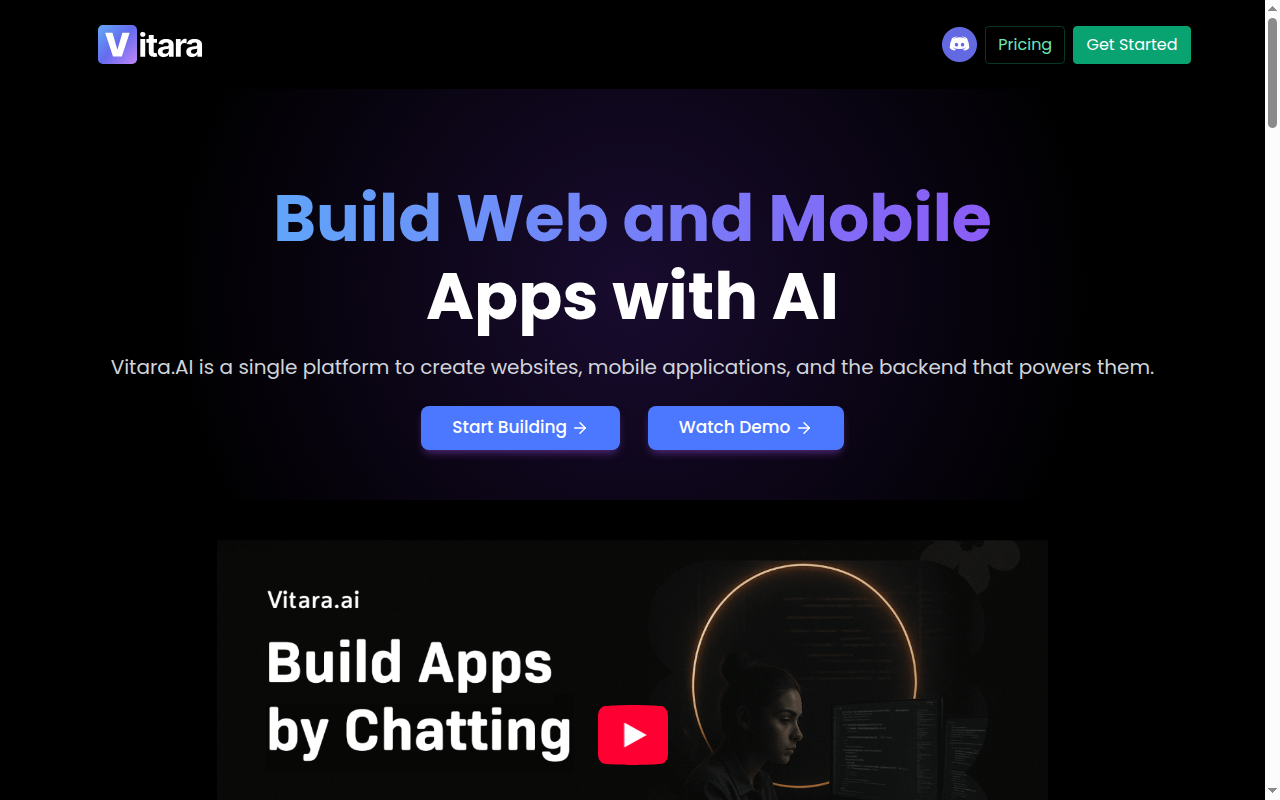
Vitara AI is a ai app builder developed by Vitara AI. It focuses on prompt-first vibe-coding platform for building software products through chat with downloadable code and custom-domain support. As a Claude Code alternative, it is best suited for teams that want a guided product-building workflow instead of a terminal-first coding loop.
Vitara AI is best for founders and product teams that want a browser-based prompt workflow for shipping software products without starting from a terminal-first development loop. It is a practical option when chat-led building speed matters more than deep CLI ergonomics. The core tradeoff is simple: Vitara AI is stronger when you want a system that generates and evolves apps as products, while Claude Code is stronger when you already live inside a repository and want a CLI agent to help with day-to-day engineering work.
That means the evaluation should not start with raw hype or category labels. It should start with workflow shape, deployment expectations, ownership needs, and who will actually operate the tool after the first successful prompt. When those questions are asked honestly, Vitara AI becomes much easier to place.
Vitara AI vs. Claude Code: Quick Comparison
| Vitara AI | Claude Code |
|---|
| Type | AI App Builder | CLI Agent |
| IDEs | Browser-based chat builder with web previews and deployment workflow | Any editor via CLI or terminal |
| Pricing | Free plan: limited usage for exploring the platform with no credit card required. | Usage-based via Anthropic API |
| Models | Not publicly documented in detail on the reviewed pages. | Claude models through Anthropic |
| Privacy / hosting | Cloud-hosted browser product with downloadable code and custom-domain deployment on paid plans. | Cloud API workflow |
| Open source | No | No |
| Offline / local models | No for the builder itself. | No |
Key Strengths
- Simple product story: Vitara frames itself as vibe coding for software products through chat. That makes the product easier to explain to founders and product teams than a more technical CLI agent. When the goal is getting from idea to visible app quickly, clarity is part of the value.
- Commercial app-builder workflow: Vitara is not just a code assistant bolted onto an editor. Its public pricing and homepage position it as a platform for building, iterating, and shipping browser-based products. That can be a better fit than Claude Code when the work starts from product ideation rather than repository maintenance.
- Code access on paid tiers: The pricing page exposes downloadable code and custom-domain support as part of the commercial offer. That is important because it gives buyers an ownership path instead of only a hosted demo. It makes Vitara more credible than tools that leave exportability vague.
- Accessible entry point: Vitara offers a free plan for trying the workflow before committing to paid usage. For teams comparing multiple AI builders, that lowers the friction of evaluation. It is especially useful when the decision maker wants to validate the prompt experience quickly.
Known Limitations
- Less transparent technical depth: Vitara's public pages are stronger on positioning than on low-level technical detail. Model support, context-window specifics, and deeper infrastructure behavior are not well documented in the reviewed material. Technical buyers may find that thinner than they would like.
- Hosted workflow with credits: Vitara's pricing is plan-based and credit-shaped, which can become a constraint for heavy iteration. That is fine for early-stage product building, but it is less attractive if your team expects constant experimentation inside one plan. Claude Code can feel simpler when the team already lives in a repository and wants an agent rather than a platform.
- Weaker fit for terminal-native engineering: Vitara is not positioned as a terminal or repo-maintenance tool. It is strongest when building new products through chat, not when debugging a mature codebase through CLI operations. That makes it an adjacent alternative rather than a universal replacement.
Best For
Vitara AI is best for founders and product teams that want a browser-based prompt workflow for shipping software products without starting from a terminal-first development loop. It is a practical option when chat-led building speed matters more than deep CLI ergonomics.
Vitara AI is most convincing when the buyer sees app generation, previewing, deployment, and stakeholder iteration as one connected workflow. It is less convincing when the job is mainly repository maintenance, heavy shell work, or a mature engineering process that already depends on terminal-native habits.
Pricing
- Plan: Free plan: limited usage for exploring the platform with no credit card required.
- Plan: Build plan: $20/month with downloadable code and custom-domain support.
- Plan: Scale plan: $50/month for heavier usage and larger monthly credit limits.
Prices are subject to change. Check the official pricing page for current details.
Tech Details
- Type: AI App Builder
- IDEs: Browser-based chat builder with web previews and deployment workflow
- Key features: prompt-first product generation, downloadable code, custom domains, browser-based build workflow, chat iteration, plan-based credits
- Privacy / hosting: Cloud-hosted browser product with downloadable code and custom-domain deployment on paid plans.
- Models / context window: Not publicly documented in detail on the reviewed pages.
When to Choose This Over Claude Code
- Choose Vitara AI over Claude Code when your priority is browser-based app generation and hosted product-building speed.
- Choose Vitara AI when downloadable code and custom-domain support matter but you still want a commercial guided workflow.
- Choose Vitara AI when non-terminal users need to participate directly in the generation loop.
When Claude Code May Be a Better Fit
- Claude Code is a better fit for repository-centric CLI work, shell tasks, and codebase maintenance.
- Claude Code is a better fit when you need a transparent terminal workflow instead of a credit-based hosted builder.
- Claude Code is a better fit when technical detail about models and engineering control matters more than guided app generation.
Implementation Notes
The practical selection question is not whether Vitara AI is smarter than Claude Code in the abstract. It is whether your team needs a product builder or a terminal agent. Those are related markets, but they solve different bottlenecks.
If your team wants to move from concept to deployed app without wiring every layer manually, Vitara AI can deliver more immediate leverage. If your team already has a repository, tests, scripts, and release discipline, Claude Code often fits the existing operating model better.
Workflow Fit and Team Adoption
Teams often make a mistake when comparing tools like these. They compare model intelligence or social hype first, then only later ask who will actually operate the workflow every day. That is backwards. The real question is whether the product lets the right people move work forward without introducing a new bottleneck.
With Vitara AI, the strongest adoption pattern usually appears when product-minded builders, technical founders, or small cross-functional teams want to collapse idea, build, preview, and deployment into one surface. That shortens the path from requirement to visible output. It also means the tool earns its keep before a full engineering handoff exists.
Claude Code, by contrast, is more natural when engineering practices are already established and the repository is the center of truth. The team already has code review, terminal habits, scripts, test commands, and deployment steps, so the best agent is the one that fits inside those routines instead of replacing them with a hosted builder mindset.
Evaluation Questions Before You Choose
Ask whether you are mostly creating a new product surface or mostly maintaining an existing software estate. If the answer is product creation, Vitara AI has a stronger case. If the answer is maintenance, debugging, or repository navigation, Claude Code likely keeps a structural advantage.
Ask how important portability is after the first success. Some teams only need a fast demo and do not care how the workflow is packaged. Other teams know from the start that they will need export, repository ownership, infrastructure control, or long-term customization. That difference changes the buying decision more than a feature checklist does.
Finally, ask who needs to collaborate. A browser-based app builder can be easier for product and design stakeholders to understand, review, and iterate on. A CLI agent can be better for engineers who already think in commits, tests, scripts, and shell commands. Good evaluation comes from matching the tool to the operator, not from assuming one category wins universally.
Conclusion
Vitara AI is a credible choice for builders who want AI to accelerate product creation rather than only accelerate line-by-line coding. It is strongest when workflow, deployment, and collaboration are part of the buying criteria, not just raw code editing.
Pick Vitara AI if you want a guided app-building surface with clearer product-generation affordances. Stay with Claude Code if your main need is a CLI-first engineering companion for real repositories, shell tasks, and day-to-day developer operations.
Sources
FAQ
Is there a free Vitara AI plan?
Yes. The pricing FAQ says there is a free plan with limited usage and no credit card required.
Can you download code from Vitara AI?
Yes. The paid-plan copy and pricing evidence reference downloadable code.
Does Vitara AI support custom domains?
Yes. The pricing evidence references custom-domain support on paid plans.
Who should skip Vitara AI?
Teams that mainly need a terminal-native coding agent for existing repositories should compare it against CLI-focused tools instead.