Potpie: A Claude Code Alternative for Custom Codebase AI Agents
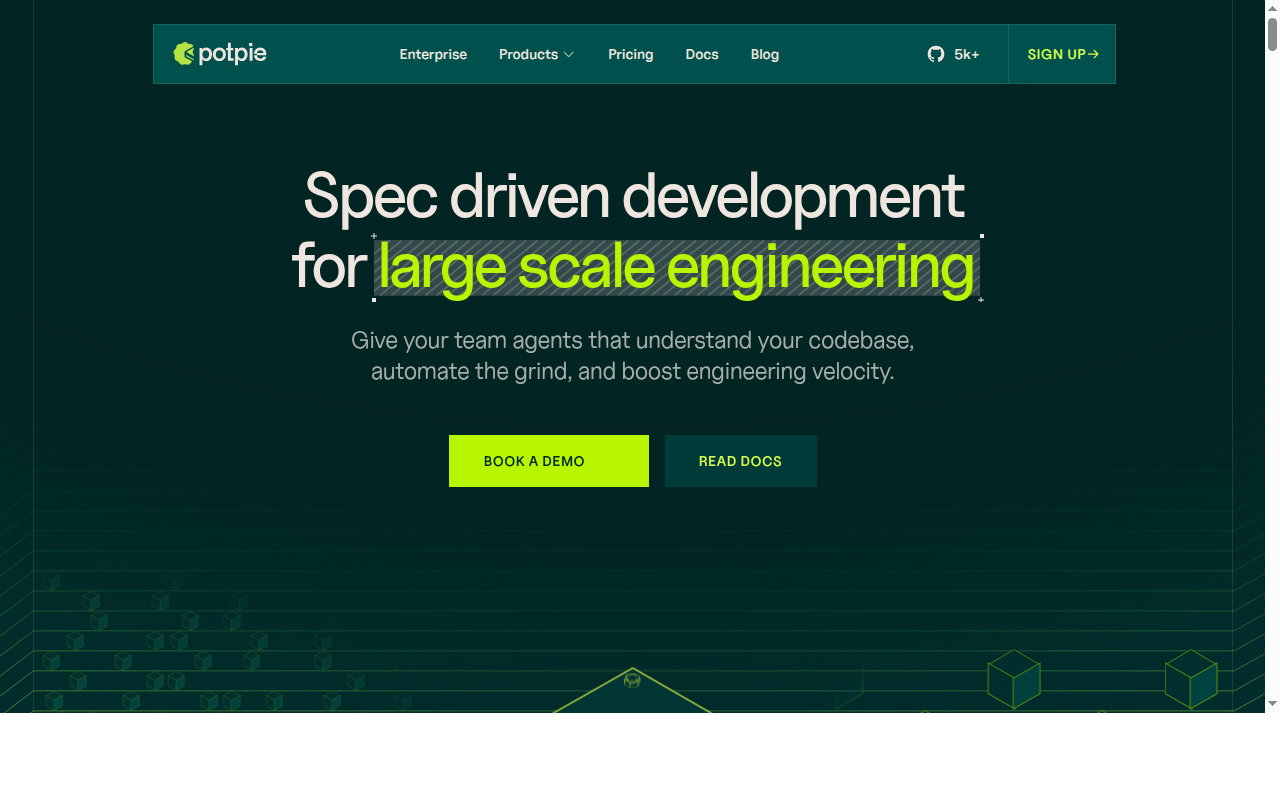
Potpie is an open-source AI app builder and custom code agent platform developed by Potpie AI. It builds task-oriented AI agents that understand your codebase through a knowledge graph, enabling precise engineering automation across debugging, system design, integration testing, and onboarding workflows. As a Claude Code alternative, Potpie is best suited for enterprise engineering teams that need codebase-aware agents with deep context — not just file-level prompts — and integrations into Slack, GitHub, and Notion.
Potpie vs. Claude Code: Quick Comparison
| Potpie | Claude Code |
|---|
| Type | AI App Builder / Custom Code Agent Platform | CLI Agent |
| IDEs | Web app (app.potpie.ai) + Slack / GitHub / Notion integrations | Any editor via CLI / terminal |
| Pricing | Custom (enterprise, per-user licensing + platform fee) | Usage-based via Anthropic API; ~$3–15/MTok |
| Models | Not publicly documented (proprietary orchestration layer) | Claude 3.5 / Claude 3 Opus |
| Privacy / hosting | Cloud (app.potpie.ai) or enterprise options | Cloud (Anthropic API) |
| Open source | Yes (5,100+ GitHub stars) | No |
| Offline / local models | Not publicly documented | No |
Key Strengths
- Knowledge graph-based code intelligence: Potpie builds a knowledge graph of your codebase, capturing relationships between modules, functions, dependencies, and patterns. This enables agents to reason about architecture-level concerns — not just individual file contents — which Claude Code's file-reading approach does not inherently replicate.
- Task-oriented custom agents (Specialists): Potpie's "Specialists" are pre-built agents for specific engineering tasks: debugging, system design, integration testing, and developer onboarding. Organizations can also build custom agents via Potpie Forge, tailored to internal workflows and coding standards.
- Enterprise-grade scale and compliance: Potpie has been tested at 50M+ lines of code and serves Fortune 500 engineering teams. The platform includes compliance and security features, making it viable for regulated industries that cannot use general-purpose CLI agents with unrestricted file access.
- Integrations with developer workflows: Potpie integrates with Slack, GitHub, and Notion, meeting developers in the tools they already use. PR review workflows, sprint planning agents, and documentation generation can be embedded directly into existing team processes.
- Open source core with 5,100+ GitHub stars: Potpie's core is open source, allowing teams to inspect, audit, and contribute to the platform. This is a meaningful advantage for security-conscious organizations evaluating vendor tools.
Known Limitations
- Custom enterprise pricing: Potpie does not publish flat rate pricing. The pricing model is per-user licensing plus a platform fee, with proposals customized per team. This makes cost estimation difficult for teams evaluating budget before a sales conversation.
- Web-app-first interface: Unlike Claude Code, which runs in any terminal, Potpie's primary interface is a web application (app.potpie.ai). Teams that prefer a pure CLI workflow or need air-gapped environments will face friction with this approach.
- Model internals not publicly documented: The underlying LLMs powering Potpie's agents are not publicly documented. Teams with requirements for specific model governance, auditability, or GDPR-related data processing agreements will need to obtain these details through a sales process.
Best For
Potpie is best suited for mid-to-large engineering organizations that want structured, codebase-aware AI agents embedded into their team workflows — not just a general-purpose chat interface. It is particularly valuable for teams working on large legacy codebases (50M+ LOC), organizations requiring compliance-grade AI tooling, and engineering leaders who want to reduce PR cycle times and improve code review consistency without manual configuration of prompt pipelines. Teams with active Slack and GitHub workflows will benefit most from the native integrations.
Pricing
- Enterprise: Custom pricing. Licenses are per user, plus a platform fee based on number of users. A customized proposal requires contacting Potpie's sales team via their website.
- Self-hosted (open source): The core is open source on GitHub (5,100+ stars). Self-hosted deployment is possible but requires configuration and infrastructure setup.
Prices are subject to change. Check the official pricing page for current details.
Tech Details
- Type: AI App Builder / Custom Code Agent Platform
- Interface: Web app (app.potpie.ai), Slack, GitHub, Notion
- Key features: Knowledge graph code intelligence, Specialists (task-oriented agents), Forge (custom agent builder), Recipes (agent workflows), Trace (agent observability), Slack/GitHub/Notion integrations
- Privacy / hosting: Cloud (app.potpie.ai); enterprise options available
- Models / context window: Not publicly documented
- Open source: Yes — github.com/potpie-ai/potpie (5,100+ stars)
- SWE-bench Lite: 63%
- Scale tested: 50M+ lines of code, Fortune 500 customers
When to Choose This Over Claude Code
- You need codebase-level agent intelligence backed by a knowledge graph, not just file-level context injection.
- You want pre-built Specialist agents for debugging, testing, or onboarding workflows without building custom prompts.
- Your team operates primarily through Slack, GitHub PRs, and Notion — and you want the agent embedded in those tools.
- You are managing a large legacy codebase (millions of lines) where architectural context is critical for accurate AI assistance.
When Claude Code May Be a Better Fit
- You need a simple terminal-based CLI agent with transparent, predictable per-token pricing — Potpie's custom pricing is harder to budget for small teams.
- You prefer a tool that runs locally in your terminal without a web application or third-party SaaS account.
- You want to know exactly which LLM is processing your code — Claude Code runs explicitly on Anthropic's Claude models, while Potpie does not publicly document its model stack.
Conclusion
Potpie is a powerful Claude Code alternative for enterprise teams that need structured, codebase-aware agents embedded into their existing development workflows. Its knowledge graph-based code intelligence, pre-built Specialists, and deep integrations with Slack, GitHub, and Notion make it a strong fit for organizations managing large codebases at scale. Teams prioritizing simplicity, CLI workflows, or transparent pricing will still prefer Claude Code — but for enterprise-grade codebase automation, Potpie is a serious contender.
Sources
FAQ
Is Potpie free to use?
Potpie has an open-source version available on GitHub. The commercial platform (app.potpie.ai) uses custom enterprise pricing — there is no self-serve free tier for the hosted product. Contact Potpie for a proposal.
Does Potpie work with VS Code?
Potpie does not have a native VS Code extension. Its primary interface is a web application, with integrations into Slack, GitHub, and Notion. It does not embed into the VS Code editor UI.
How does Potpie compare to Claude Code?
Claude Code is a terminal-based CLI agent that operates at the file and shell level. Potpie is a web-platform that builds codebase-wide knowledge graphs and creates task-oriented agents for specific engineering workflows. Potpie requires a sales engagement for enterprise pricing; Claude Code costs are based on Anthropic API token usage with public per-token rates.
What is Potpie's SWE-bench score?
Potpie achieves 63% on SWE-bench Lite, as documented in its GitHub Pull Request to the SWE-bench experiments repository. This places it among the competitive open-source coding agent platforms.