Momen: A Claude Code Alternative for AI-Led App Building
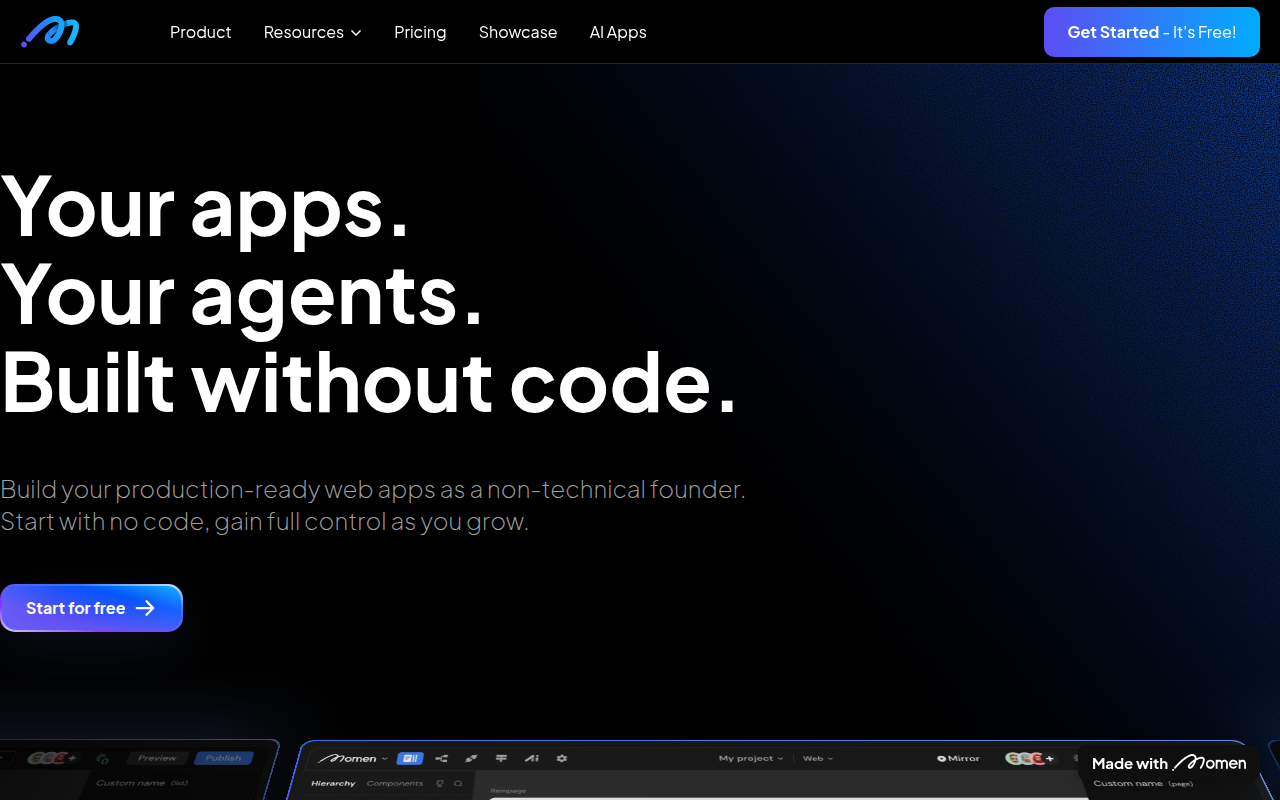
Momen is a AI app builder developed by Momen. AI-assisted no-code web app builder with built-in data logic, visual workflows, and a production path for shipping full web apps. As a Claude Code alternative, it is best suited for teams that want AI to assemble more of the application itself instead of staying inside a terminal-first coding workflow.
Momen vs. Claude Code: Quick Comparison
| Momen | Claude Code |
|---|
| Type | AI app builder | CLI agent |
| Surface | Browser-based visual builder with built-in data, workflows, previews, and hosted publishing | Terminal-first workflow across existing repositories |
| Pricing | Free, then Basic at $33 per project per month billed annually, Pro at $85 per project per month billed annually, and Enterprise custom pricing. | Anthropic-managed Claude Code access or usage-based Claude model spend |
| Models | Not publicly documented in detail on the reviewed official pages. | Anthropic Claude models inside a CLI workflow |
| Privacy / hosting | Hosted builder. The official product story emphasizes managed app delivery more than local or self-hosted control. | Cloud-oriented model workflow |
| Open source | No | No |
| Offline / local models | No | No |
Key Strengths
- Momen solves a different problem than Claude Code. It is optimized for founders and builders who need to assemble a working product, data model, and automation flow from one guided surface instead of accelerating line-by-line coding inside an IDE.
- The public product story is unusually concrete about app-building primitives. Built-in tables, workflows, previews, and publishing mean a team can move from idea to a structured web product without first designing the whole backend and frontend architecture manually.
- It is also stronger than many browser builders on business realism. Momen talks directly about scale, logic, and product delivery instead of stopping at landing-page generation, which makes it more credible for teams building serious internal tools or SaaS prototypes.
Known Limitations
- Momen is not a repository-native coding environment. Teams that already think in pull requests, test suites, shell workflows, and long-lived code reviews will feel more constrained here than in a coding assistant workflow.
- The pricing model is app-platform shaped, not developer-seat shaped. Per-project tiers plus add-on style economics can become harder to forecast as traffic, automation, or app complexity grows.
- The official pages are more persuasive on shipping apps than on portability. There are code-aware features, but this is still a managed builder and not a Claude Code-style assistant embedded into daily engineering routines.
Best For
Momen is best for technical founders, product-minded operators, and small teams who want to ship a database-backed web app quickly without centering the whole workflow on writing code inside an IDE.
It is especially relevant when the immediate bottleneck is product assembly rather than coding throughput. In that phase, a guided app builder can be a more honest alternative than another autocomplete or agent layer on top of existing engineering tools.
Pricing
- Pricing summary: Free, then Basic at $33 per project per month billed annually, Pro at $85 per project per month billed annually, and Enterprise custom pricing.
- Official proof: Official pricing page confirms Free, Basic at $33/project/month billed annually, Pro at $85/project/month billed annually, and Enterprise custom pricing.
- Notes: Builder pricing should be judged against app-delivery scope, not only against terminal-agent cost.
Prices are subject to change. Check the official pricing page for current details.
Tech Details
- Type: AI app builder
- Surface: Browser-based visual builder with built-in data, workflows, previews, and hosted publishing
- Key features: visual builder, built-in database logic, Actionflow automation, app publishing, GraphQL API, React components, JavaScript logic
- Privacy / hosting: Hosted builder. The official product story emphasizes managed app delivery more than local or self-hosted control.
- Models / context window: Not publicly documented in detail on the reviewed official pages.
- Open source: No
- Offline / local: No
When to Choose This Over Claude Code
- Choose Momen over Claude Code when the real job is creating a web app product with data, workflows, and publishing from one managed builder.
- Choose it when non-engineers or mixed-skill teams need to participate directly in shaping the app instead of translating every change through developers.
- Choose it when shipping a structured MVP matters more than preserving an IDE-first engineering loop from day one.
Momen fits the phase where product shape matters more than code artistry. The builder, data layer, and logic tooling live close together, so the user can make meaningful progress without designing every technical decision in advance.
That makes it a credible Claude Code alternative only for teams whose comparison set includes app builders. If the buyer really wants help inside VS Code, JetBrains, or the terminal, Momen is solving an earlier and broader product-creation problem instead.
When Claude Code May Be a Better Fit
- Claude Code is a better fit when the team already has a repository-centered workflow and mainly wants faster coding, refactors, and code review assistance inside familiar tools.
- Claude Code is a better fit when portability, developer control, and daily engineering ergonomics matter more than a managed app-builder workflow.
- Claude Code is a better fit when the product is already being maintained as software rather than being formed as a browser-led app concept.
Claude Code remains the cleaner default when the team already lives in repositories, shell workflows, tests, and review loops. A terminal-native agent can amplify an existing engineering process without forcing the organization to adopt a builder-shaped operating model.
That matters because app builders can look broader and more impressive at first glance. The real question is whether the team needs AI to write and revise software inside current codebases, or whether it needs AI to assemble more of the product surface before classic engineering habits even start.
Workflow and Team Adoption
Adoption success depends on who owns the artifact after the first generated version appears. Builder-first products create the most value when product, operations, or founder stakeholders need direct control over the app-building loop instead of handing every change to engineers.
The same workflow can become a drawback if long-term maintenance will clearly sit with developers inside repositories. In that case, a terminal agent such as Claude Code may create less organizational friction because it stays closer to normal engineering rituals and ownership boundaries.
Momen should therefore be tested against one concrete project slice. The best evaluation is not whether the tool can generate something flashy once, but whether it makes a real app easier to ship, revise, and hand off over several weeks of actual use.
Cost and Governance
Cost should be measured across the whole workflow. Some teams will happily pay more than a coding-agent budget if the platform removes backend setup, preview wiring, mobile packaging, or distribution friction. Other teams will realize they only needed better coding assistance, in which case a builder is paying for the wrong layer of the stack.
Governance also changes. Claude Code keeps the center of gravity in engineering tools, while Momen asks the buyer to accept more managed product logic, or more setup work, or both. The stronger option depends on whether the team values platform convenience, open-source control, or repository-native continuity.
For that reason, builders should be reviewed by the people who own product speed, budget predictability, deployment expectations, and long-term maintainability. The most credible alternative is the one that matches those constraints, not the one with the noisiest launch demo.
Implementation Realities
The implementation reality is usually where tool selection becomes honest. A builder can win the first impression because it produces an app shell quickly, but the real test begins when the team needs revisions, integrations, deployment stability, and repeatable ownership after the initial generation pass.
Momen should therefore be judged on how well it supports the second and third iteration, not only the first one. Teams that repeatedly change requirements, validation logic, data structure, or release targets need to know whether the product keeps helping once the novelty of prompt-to-app generation wears off.
Claude Code has a simpler story here because it remains inside a terminal-centric engineering workflow. That usually means more manual responsibility, but it also means fewer surprises about where code lives, how changes are reviewed, and which parts of the process remain under direct developer control.
Migration Considerations
Migration risk should be weighed before a team standardizes on any builder-led alternative. If the software eventually has to move into a more conventional repository workflow, the cost of that transition can erase some of the speed gained during the first launch phase.
This does not make builder platforms a bad choice. It simply means the buyer should know whether the goal is fast validation, long-term product ownership, or a blend of both. The more clearly that question is answered upfront, the easier it becomes to judge whether Momen is the right long-term fit against Claude Code.
For teams that already know they will keep evolving the product through developers, the migration story matters more than the demo speed. For teams that only need to validate demand quickly, shipping convenience may matter far more than future workflow purity.
Practical Scenarios
One practical scenario is a founder-led MVP where product speed matters more than engineering elegance. In that environment, a builder such as Momen can create leverage because it reduces the amount of up-front technical coordination required before users see something real.
Another scenario is a developer-led product team with an existing codebase and a strong review culture. That environment often favors Claude Code because the agent can work inside the repository habits the team already trusts, instead of asking everyone to move into a more opinionated generation product.
A third scenario sits between those extremes: mixed-skill teams that want to validate product shape quickly, then decide later whether the software should stay in the builder or move deeper into a conventional engineering lifecycle. Those teams should pay special attention to portability, export, integration depth, and revision speed.
Decision Checklist
- Choose Momen if your main bottleneck is turning product ideas into deployable application structure faster than a terminal coding workflow can support.
- Choose Claude Code if your main bottleneck is editing, refactoring, testing, and reviewing code inside repositories that already exist.
- Prefer the builder path when non-engineering stakeholders need direct influence over the output rather than handing specifications to developers.
- Prefer the terminal-agent path when long-term maintainability, repository ownership, and engineering discipline matter more than the breadth of the first generated deliverable.
Conclusion
Momen is best for technical founders, product-minded operators, and small teams who want to ship a database-backed web app quickly without centering the whole workflow on writing code inside an IDE.
It is especially relevant when the immediate bottleneck is product assembly rather than coding throughput. In that phase, a guided app builder can be a more honest alternative than another autocomplete or agent layer on top of existing engineering tools.
If your team mainly wants an AI partner inside terminal-driven software engineering, Claude Code remains easier to justify. If your team wants AI to take on more of the app-building loop itself, Momen is a credible option in the AI app builder category and deserves evaluation on that basis.
Sources
FAQ
Is Momen free?
Yes. The official pricing page shows a Free plan, with paid per-project tiers for more serious production usage.
Does Momen replace Claude Code for developers?
Only in app-builder scenarios. It is stronger when the team wants to assemble and launch an app from a guided builder, not when it wants day-to-day coding assistance inside an IDE.
Who should choose Momen over Claude Code?
Founders, operators, and mixed-skill teams who care more about getting a working web app online than about accelerating repository-native coding.
What is the main tradeoff?
You gain a managed app-building workflow, but give up the codebase-native flexibility and engineering ergonomics that make Claude Code attractive.