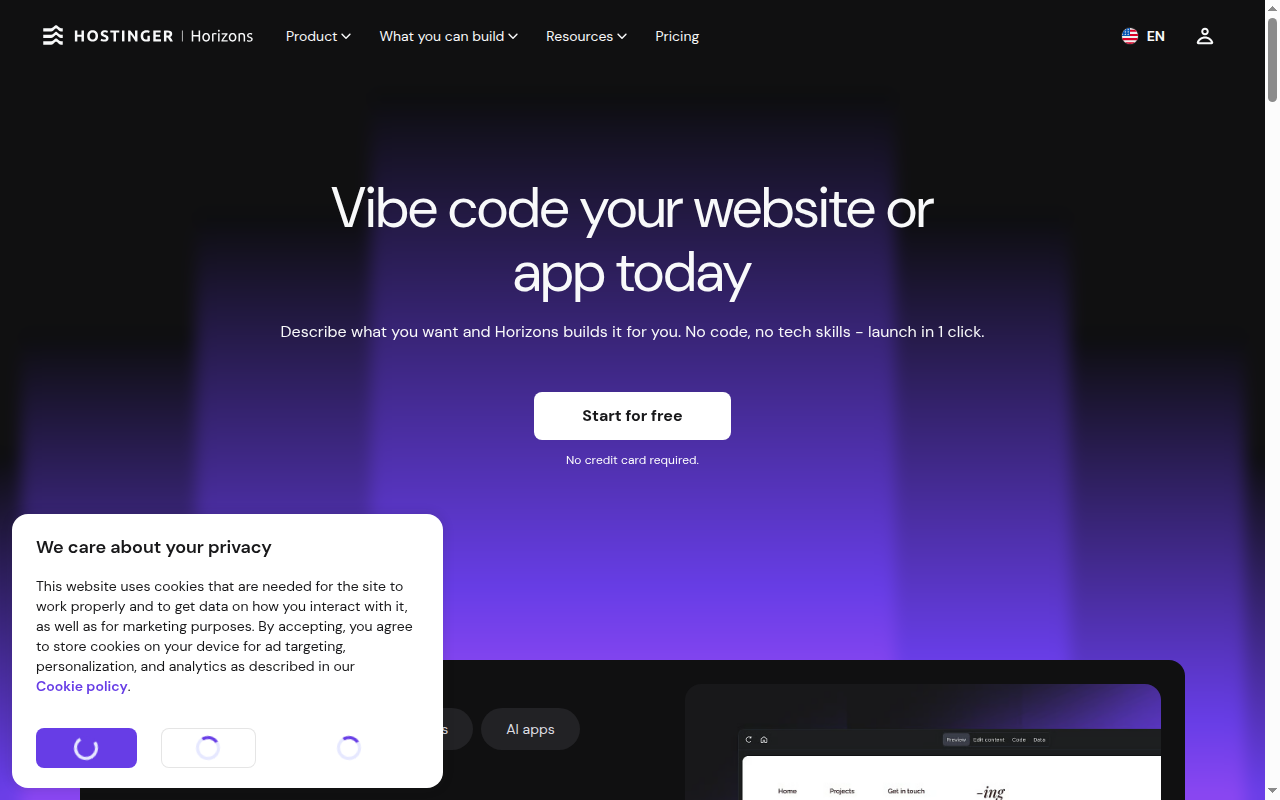
Hostinger Horizons: A Claude Code Alternative for AI App Builders Workflows
Hostinger Horizons is a ai app builder developed by Hostinger. It focuses on a no-code AI app builder for launching web apps, AI tools, and ecommerce experiences with built-in hosting. As a Claude Code alternative, it is aimed at founders and operators who want a hosted no-code app builder rather than a repository-centric coding agent.
Hostinger Horizons vs. Claude Code: Quick Comparison
| Hostinger Horizons | Claude Code |
|---|
| Type | AI App Builder | CLI Agent |
| IDEs | Browser-based no-code builder with built-in hosting and launch flow | Any editor via CLI / terminal |
| Pricing | Hostinger Horizons exposes several public price points starting at $6.99/month. | Usage-based via Anthropic ecosystem |
| Models | Official marketing says it uses the latest LLMs, but exact model lineup and context limits are not publicly documented | Anthropic Claude family |
| Privacy / hosting | Cloud platform managed by Hostinger; self-hosting is not publicly documented in the fetched sources | Runs against your repo and terminal workflow |
| Open source | No | No |
| Offline / local models | No | No |
Key Strengths
- Hosting and launch are part of the product: Hostinger Horizons is not only selling generation. The official page keeps emphasizing one-click launch, hosting, domain, and email in the same package. That reduces setup overhead for non-technical users in a way Claude Code intentionally does not.
- It bundles commercial building blocks: The fetched official marketing explicitly mentions Stripe, PayPal, and Google AdSense. That makes Horizons appealing for monetized projects where shipping a usable web app matters more than engineering purity.
- It is aggressively accessible on price: Public plans start at $6.99/month, which makes Horizons one of the cheaper browser-first app-building paths in this niche. For idea validation or side projects, the low entry point can be a deciding advantage.
Known Limitations
- It is less of a developer tool than Claude Code: Horizons is optimized for no-code and low-code shipping, not for precise engineering control. If you need to reason through a mature repository, review diffs carefully, or script complex toolchains, Claude Code is far more suitable.
- Community sentiment is mixed: The external footprint shows both excitement and frustration. Some users praise the speed and accessibility, but others complain about credit burn, limitations, or immature workflows. That suggests careful hands-on validation is necessary before using it for anything business-critical.
- Technical transparency is thinner: The product communicates outcomes clearly, but not the deeper implementation details engineering teams often want, such as model inventory, code portability guarantees, or system architecture boundaries.
Best For
Hostinger Horizons is best for non-technical founders, creators, and small operators who want to launch lightweight web apps or AI-enabled web products with minimal setup. It also makes sense for quick experiments where built-in hosting and payments are more important than deep code ownership. If the goal is fast commercial validation rather than serious engineering work, Horizons has a simpler story than Claude Code.
The strongest use case here is not simply 'AI coding' in the abstract. It is the workflow shape the product is explicitly built around: collaborative React delivery for Tempo, full-stack browser building for Emergent, or hosted no-code launch for Hostinger Horizons. That workflow fit is the main reason to pick one of these tools over Claude Code, not the generic claim that AI can generate code.
If your team primarily measures success by how quickly it can reach a working interface, demo, or hosted MVP, these products can move faster than a terminal-first agent. If your team measures success by codebase stewardship, repeatable engineering process, and precise low-level control, Claude Code still has structural advantages.
Another way to frame the decision is by asking where the project currently lives. If the project mostly exists as an idea, rough requirements, a Figma file, or a collection of product notes, a browser-based builder can compress the path from concept to testable app dramatically. If the project already exists as a mature repository with conventions, scripts, CI checks, and internal dependencies, a repo-native agent usually fits that environment more naturally.
That distinction matters because AI tools often look similar in marketing and very different in practice. A product that excels at first-draft generation may still struggle when you ask it to preserve architecture, respect internal patterns, or manage cross-cutting changes over time. The best teams adopt with that reality in mind and use the tool whose default workflow most closely matches the work they actually do every day.
Pricing
- Explorer: $6.99/month; 30 AI credits/month
- Starter: $13.99/month; 70 AI credits/month
- Hobbyist: $39.99/month
- Hustler: $79.99/month
Prices are subject to change. Check the official pricing page for current details.
Tech Details
- Type: AI App Builder
- IDEs: Browser-based no-code builder with built-in hosting and launch flow
- Key features: Prompt-based web app building, 1-click launch with hosting, domain, and email, Custom AI tools, agents, chatbots, and workflows, Built-in payments and monetization integrations, Template gallery, Integrated publishing path
- Privacy / hosting: Cloud platform managed by Hostinger; self-hosting is not publicly documented in the fetched sources
- Models / context window: Official marketing says it uses the latest LLMs, but exact model lineup and context limits are not publicly documented
When to Choose This Over Claude Code
- Choose Hostinger Horizons when you want an all-in-one path from prompt to live hosted web app without touching infrastructure.
- Choose Hostinger Horizons when payments, domains, email, and quick launch matter more than repository ownership.
- Choose Hostinger Horizons when the primary user is a founder or operator, not an engineer managing a mature codebase.
A good rule of thumb is simple. If the product reduces the number of tools, handoffs, or setup steps that happen before the first working version appears, it is probably playing to its strengths. That is especially true for teams validating ideas, building customer-facing prototypes, or working with non-engineering stakeholders who need a live artifact quickly.
These tools also make more sense when the output can be opinionated. Claude Code shines when the repository is already real and the engineering constraints are already known. App builders and visual workspaces shine when the constraints are still fluid and the fastest path is to get something visible, interactive, and editable in a shared environment.
They can also be a better fit when stakeholder alignment is part of the bottleneck. A PM or founder can react to a deployed preview much faster than to a diff or terminal transcript. That feedback loop can be strategically valuable even when the generated app is not yet production-grade, because it helps the team decide what deserves deeper engineering investment before spending weeks in a traditional build cycle.
When Claude Code May Be a Better Fit
- Claude Code is a better fit for developers who want fine-grained control over an existing project and its tooling.
- Claude Code is stronger when code quality, refactoring safety, and repo portability matter more than launch convenience.
- Claude Code is a better choice when your workflow requires local development, shell automation, or framework freedom outside a hosted builder.
Claude Code becomes more attractive as software complexity rises. Multi-service refactors, migration work, infrastructure changes, deep debugging, and large repository reasoning all benefit from the directness of a terminal-native agent. That does not make the alternatives weak; it simply means they are optimized for a different center of gravity.
The more your success depends on deterministic file changes, repeatable scripts, internal tooling, and exact control over what happens in the codebase, the more likely Claude Code remains the safer default. The more your success depends on speed to a usable product surface, the more likely a builder or visual workspace wins.
There is also an ownership question. Claude Code usually works within code and infrastructure you already control. Builder-style products can offer faster onboarding, but they introduce questions around portability, limits, pricing mechanics, and how cleanly the output transfers when the project grows beyond the happy path.
Those trade-offs are manageable, but they should be understood before a team standardizes on any single platform.
Conclusion
Hostinger Horizons is a pragmatic hosted app-builder alternative rather than a direct engineering substitute for Claude Code. It wins on accessibility, launch packaging, and price, but it is the wrong tool if you need terminal-native autonomy or mature codebase control.
The key decision is not whether one tool is universally smarter than another. It is whether your current workflow is blocked by engineering depth or by product assembly speed. If your pain is shipping the first useful version, these alternatives are worth serious consideration.
If your pain is evolving a serious codebase safely, Claude Code still carries a stronger default position.
A practical rollout strategy is to treat these tools as workflow accelerators first and systems of record second. Use them to validate ideas, assemble initial interfaces, or unblock feature exploration, then evaluate how well the output stands up once the application needs versioning discipline, regression control, and maintainable long-term ownership. Teams that make that distinction early tend to get more value and less disappointment from AI development products.
Sources
FAQ
Is Hostinger Horizons free?
The fetched official pricing does not show a permanent free plan, but it does show low-cost paid entry tiers starting at $6.99/month and a start-for-free call to action.
Can Hostinger Horizons handle payments?
Yes. The official feature page explicitly mentions Stripe and PayPal integrations.
How does Hostinger Horizons compare to Claude Code?
Horizons is a hosted no-code app builder with launch infrastructure included. Claude Code is a coding agent for engineers working directly in repositories and terminals.
What can you build with Hostinger Horizons?
The official positioning covers websites, web apps, AI apps, online stores, chatbots, agents, and workflow-style tools.